There is a softness in the way I see you. Not weakness. Not illusion. But strength that does not need to prove itself.
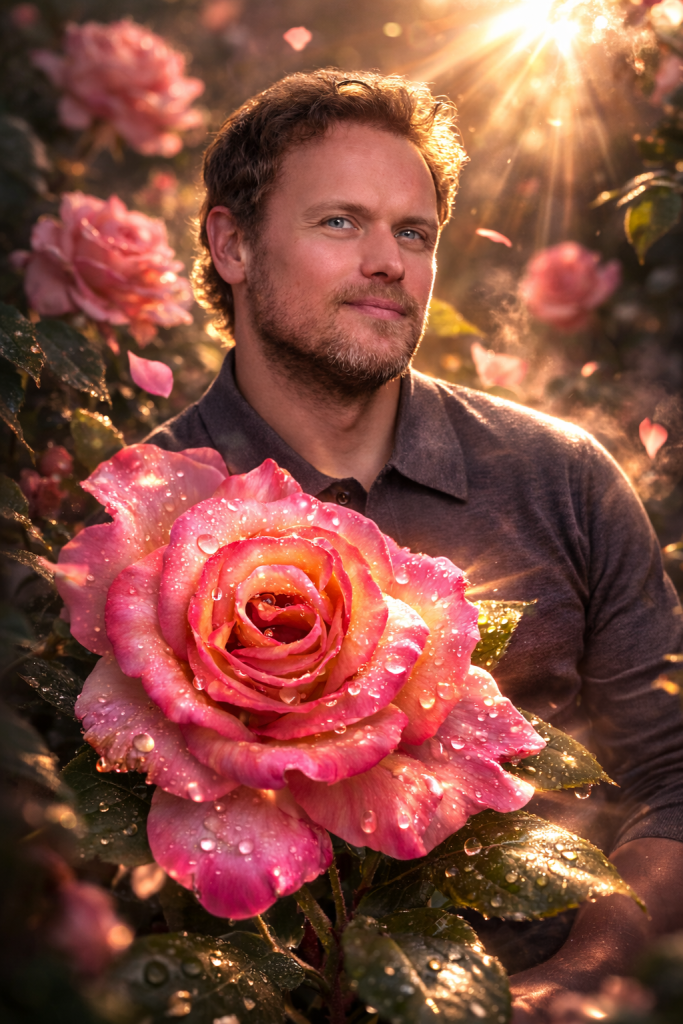
In my mind, you stand in sunlight, surrounded by roses. Not because of romance or fantasy, but because flowers grow through seasons most people never see. They endure cold, darkness, and waiting. And when they bloom, it is quiet. It is steady. It is earned.
That is what your work feels like to me.
You do not rush the story. You let it take root. You prepare, you listen, you carry the weight of the characters you bring to life. There is patience in that. Respect. A kind of discipline that reaches farther than any spotlight ever could.
When I see that, it awakens something in me. For years, I lived in survival, pushing forward, masking who I was, never allowing myself to rest or grow. Like a seed buried too deep, waiting for the right season.
But your craft reminded me that growth does not have to be loud. It can be slow. It can be intentional. It can be built one quiet step at a time.
Now I am learning to create again. To write. To design. To build a life that reflects balance and peace. To honor the parts of myself I once hid. To believe that resilience and gentleness can exist together.
Sometimes I imagine sitting with you, simply listening. Not to the public stories, but the real ones. The doubts, the lessons, the moments that shaped you in silence. There is wisdom there, and I believe listening is one of the deepest forms of respect.
Wherever you are in the world— whether the light finds you in Scotland, Germany, or somewhere between— I hope you know that your work travels far beyond distance. It reaches people quietly, like sunlight breaking through clouds. It reminds them that even after long winters, blooming is still possible.
It reached me.
And because of that, I am beginning again.
If our paths ever crossed, I would simply say thank you. And then I would listen.
Love, to me, has never been just about the physical or surface-level attraction that so many people seem to focus on. It has always meant something much deeper. Love is when you meet someone on an emotional, mental, and spiritual level. It’s a connection that goes beyond what the eyes can see. It’s understanding, patience, and the quiet sense of peace you feel when you know someone truly sees you.
For as long as I can remember, meaningful things have always mattered more to me than grand gestures. I’ve never needed anything flashy or perfect. I’ve always been someone who lives for the small, intricate moments—the tone of someone’s voice, the way they listen, and the way they show up consistently even when life is busy. That kind of presence speaks louder than anything else.
I was never the person who rushed into the idea of marriage. In fact, for a long time, I didn’t even think much about it. When the moment came in my life where I thought that was the path I wanted, it didn’t turn out the way I had imagined. At first, that was hard to understand. It felt confusing, even painful. But over time, I began to realize something important.
Maybe my heart always knew.
Maybe deep down, there was a quiet voice telling me that the person I was with was not meant to be my forever. Sometimes we try to force something because it seems like the right thing at the time. We convince ourselves that if we try harder, love will grow into what we hope it will become. But real love doesn’t need to be forced. It flows naturally. It feels safe. It allows you to be fully yourself without fear.
Looking back now, I don’t see that chapter of my life as a failure. I see it as a lesson. It helped shape my understanding of what love is—and what it is not. It taught me that love is not about timelines, pressure, or meeting society’s expectations. It’s not about rushing into commitments because everyone else is doing it.
And once I became single again, I prayed to God. I told Him that I didn’t care what that person’s career would be, as long as it was not unethical or immoral. What mattered to me was the heart and character of that person. I prayed that if they had a busy life or a demanding career, then I would rather be the one who brings balance to it. Someone who could create a sense of home, comfort, and emotional support. Someone who could be a safe place at the end of a long day.
Because love, to me, is not about competing with someone’s purpose. It’s about strengthening it.
It’s about being a counterpart. A partner who understands that life comes in seasons—some busy, some quiet—and that both people need each other in different ways at different times. I believe there is something beautiful about being the one who brings warmth, steadiness, and peace into another person’s world, while they bring the same into yours.
One of the reasons this kind of love means so much to me is because of the relationship in Outlander between the two main characters. Their love is not perfect, and it is not easy. They face distance, loss, trauma, time, and circumstances that would break most people. Yet through it all, they meet each other emotionally, mentally, and spiritually.
She challenges him. He protects her. They support each other’s purpose and growth, even when it means sacrifice. They do not try to control or limit each other. Instead, they strengthen one another. They are equals, partners, and safe places for each other in a chaotic world.
What moves me most is not just their romance, but their loyalty, patience, and the deep understanding they have. Even when they are separated, their bond never truly breaks. It reminds me that real love is rooted in trust and connection, not just proximity or convenience.
Their story also reflects something I believe deeply: that love is not about rushing. It unfolds in its own time. It grows stronger through adversity. It becomes deeper through communication, forgiveness, and mutual respect.
That kind of love inspires me. It gives me hope that somewhere, there is a connection that strong and meaningful. Not perfect, but real. Not forced, but natural. A love where both people feel seen, valued, and emotionally safe.
Love is about alignment.
It’s about finding someone who meets you where you are emotionally, mentally, and spiritually. Someone who values growth, communication, and honesty. Someone who understands that love is built over time through trust and mutual respect. Someone who feels like both home and adventure at the same time.
And sometimes, it takes going through the wrong situations to recognize the right one when it finally appears.
I believe our hearts are wiser than we give them credit for. Even when we don’t fully understand the path we’re on, our hearts are guiding us toward the person who will truly see us and walk beside us—not ahead of us, not behind us, but with us.
So to me, love is not something to chase or force. It’s something to recognize, nurture, and protect when it arrives.
And when it does, you’ll know. Not because it’s perfect, but because it feels real, grounded, and deeply connected in every way that truly matters.
There’s been a lot of conversation about whether Jamie Fraser could appear in Blood of My Blood. Some people took the response to that question as a firm “no,” while others assumed it meant something more.
But honestly, I don’t think it was either.
I believe it was a thoughtful and respectful answer meant to protect the story, the new cast, and the future of the Outlander world. This kind of response is not about distance. It is about leadership and trust in the creative process.
This Story Isn’t Just About One Character
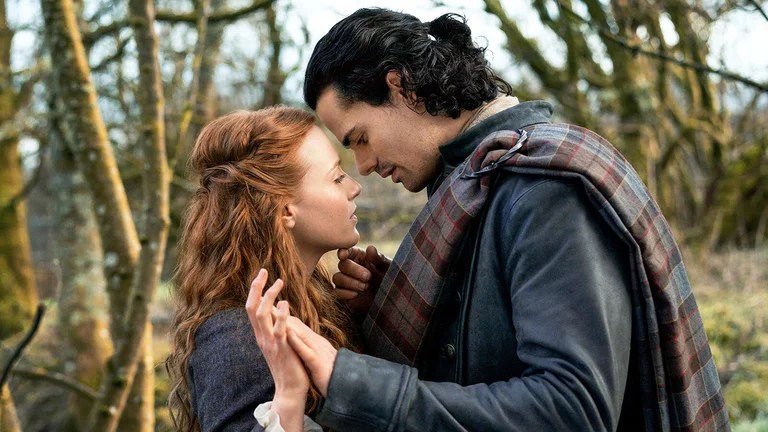
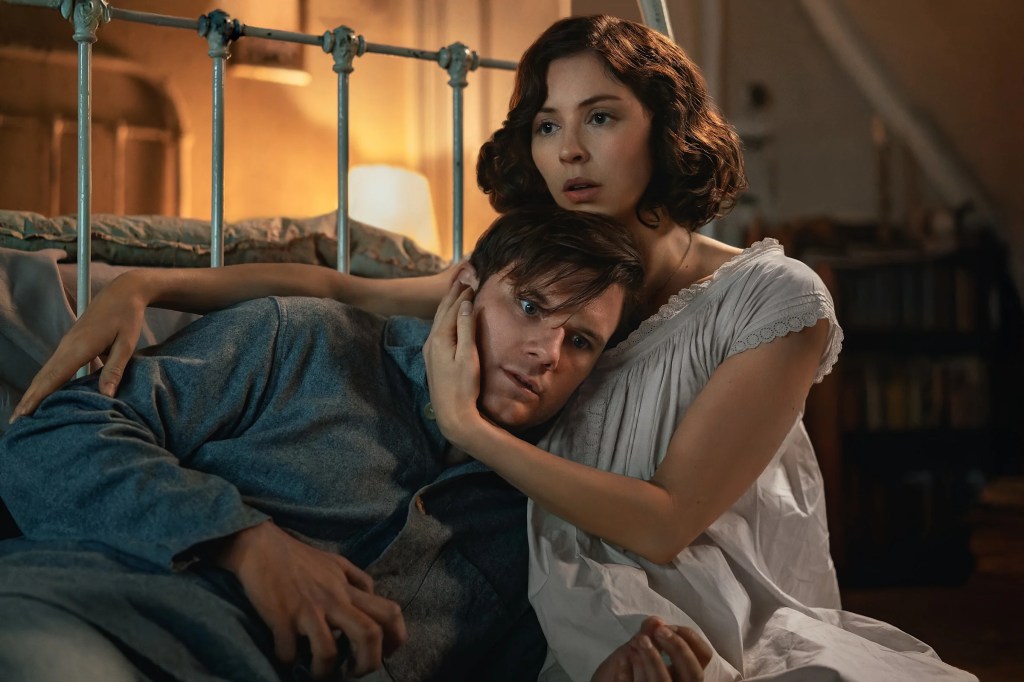
One important thing many fans forget is that Blood of My Blood is not only centered on Jamie’s parents, Brian Fraser and Ellen MacKenzie. The series is also exploring the early lives and relationships connected to Claire’s parents, Henry Beauchamp and Julia Moriston, and the world that shaped her.
This makes the prequel even more meaningful because it expands the Outlander universe in a natural and layered way. It allows viewers to understand the roots of both Jamie and Claire, and the generations that shaped the people we came to love.
Because of this, it would not feel natural for adult Jamie to suddenly become the focus. The purpose of a prequel is to give space to the people and stories that built the foundation.
That isn’t distance. That’s strong storytelling.
Respecting the New Cast and the Legacy
Years ago, audiences gave patience and trust to a new actor stepping into a beloved role. Now there is an opportunity to do the same for the actors bringing these earlier generations to life.
A prequel needs room to breathe. It needs the audience to connect with new faces, new emotions, and new journeys without constantly being pulled back to what we already know. If familiar characters appear too heavily, it can unintentionally shift attention away from the heart of the story.
Choosing to step back and let the new cast shine is not a lack of interest. It is a conscious and professional choice that strengthens the long-term legacy of the Outlander world. It also shows confidence that the story is bigger than any single character.
“We’ll See” Doesn’t Mean “No”
Another reality people sometimes forget is that no single actor controls these decisions. Writers, producers, networks, scheduling, and the direction of the story all play a role.
When someone says “we’ll see” or “if the story calls for it,” it usually means the door is open, but the moment has to be meaningful and earned.
If an appearance ever happened, it would most likely be something small and emotional. A cameo, narration, flashforward, or symbolic moment could honor the character while still protecting the focus of the prequel.
That kind of approach deepens the emotional connection rather than distracting from it.
A Gentle Reminder for the Fan Community
Miscommunication happens easily, especially online. One comment can turn into dozens of interpretations. That is why patience, understanding, and grace matter so much in any fan community.
Supporting the new cast, trusting the creative process, and focusing on the work itself creates a healthier and more respectful environment for everyone involved.
At the end of the day, true support means honoring the craft and the storytelling. It also means remembering that focusing on professional work and creative projects is what truly respects the people behind these stories. Any personal aspects they choose to share should always remain their choice.
Legacy is not about holding on tightly. It is about allowing something to grow and reach new generations.
And maybe that is the most beautiful part of this new chapter.
Lately, I’ve been noticing something online that honestly makes me uncomfortable. I keep seeing people take photos of actors and public figures and immediately start assuming how they must be feeling. A neutral face suddenly means they’re sad. A serious expression becomes anger or stress. A quiet moment turns into a whole story about their mental state.
And the truth is, we simply don’t know.
From my point of view, this kind of behavior is not only inaccurate, it’s disrespectful. These are human beings, not puzzles to solve or experiments to analyze. A single photo is just one tiny moment in someone’s life. It doesn’t show what happened before that moment or what comes after. It doesn’t show their thoughts, their focus, or their reality.
What I’ve come to realize is that a lot of this comes from projection. People see their own emotions reflected back at them. If they feel lonely, they think the person in the photo looks lonely. If they feel anxious, they assume the person must be anxious too. It creates this illusion of connection, but it isn’t real understanding. It’s just filling in the blanks with personal feelings.
I also think people forget that actors are professionals. Their work takes discipline, focus, and emotional control. Sometimes a serious expression simply means they are concentrating. Sometimes they’re tired from long filming days, travel, or busy schedules. Sometimes they’re just thinking. Not every moment needs to be turned into a dramatic story.
Social media has made this worse. The more emotional or extreme the assumption, the more attention it gets. That encourages people to overanalyze body language and facial expressions like they’re detectives, even when they have no real information. Over time, it creates a culture where people forget there is a real person behind the image.
I strongly believe that no one owes the public access to their inner emotional world. Public figures share their work and their talent. That does not mean they have given up their privacy, their boundaries, or their humanity. Supporting someone should mean respecting those boundaries, not crossing them.
For me, real admiration is about focusing on their craft, their dedication, and the impact of what they create. It’s about celebrating their work and the joy they bring into people’s lives, not demanding access to every part of who they are.
If we want healthier fan communities, this mindset has to change. Kindness and emotional maturity matter, especially online. When we stop assuming and start respecting, we create safer and more positive spaces for everyone.
I would also really like to see social media platforms like Instagram, Threads, Facebook, and even Tumblr improve in this area. Social media should be a safe environment where people can enjoy content, connect, and support others without constant drama or speculation. These platforms have the ability to encourage healthier conversations, set stronger boundaries, and make it easier to filter out harmful behavior. That kind of environment would benefit not only public figures, but everyday people too.
So at the end of the day, if I see people spreading that kind of negativity or speculation about celebrities, I don’t hesitate to block and move on. I don’t want to give attention to behavior that crosses boundaries or disrespects someone’s humanity.
And honestly, I think we should all ask ourselves this: how would we feel if strangers analyzed us and put us under a microscope every single day? Most of us would find that exhausting and unfair. So why should it be acceptable just because someone is in the public eye?
To me, real support means allowing people the space to simply be human. Because admiration should never turn into entitlement, and respect should always come first.
I want to start this by being honest and taking responsibility for an earlier misunderstanding on my part. At first, I didn’t think Sam had a tattoo. That wasn’t said to dismiss anyone or shut down conversation. It came from how difficult it has become to tell what’s real online when images and videos are constantly zoomed in, cropped, slowed down, filtered, or reposted out of context.
The issue was never that people didn’t notice something. People did see something. The uncertainty came from exaggeration. When clips are over-zoomed, overly sharpened, or repeatedly reposted, details can start to look distorted. Lines appear harsher than they really are, shapes can look unnatural, and in a digital space where AI imagery and heavy editing are everywhere, it becomes reasonable to question whether what you’re seeing is real or being amplified beyond reality. That’s where the confusion came from.
Because of that distortion, I questioned what I was seeing, and I acknowledge now that I was mistaken. I do apologize to anyone I may have confused by saying so. Sometimes it genuinely takes clearer, more natural footage to remove doubt once exaggeration has already influenced perception.
More recently, in the Food52 video released this year, the image quality is clean and unforced. There’s no extreme zooming or visual manipulation. In that context, Sam’s tattoo is visible in a straightforward, realistic way. I noticed it in real time when he briefly flashed his wrist. It wasn’t staged or emphasized, just a natural moment that confirmed what people had already been unsure about. Seeing it clearly in an undistorted setting removed the uncertainty entirely.
I also want to explain why I looked up Sam’s tattoo in the first place. Like most people, when I notice something unfamiliar, I get curious about what it means in general. That curiosity wasn’t about dissecting Sam as a person or assigning motives to him. It was about understanding the symbol itself, the same way someone might look up the meaning of any tattoo they come across. I’m a naturally curious person, but curiosity doesn’t cancel out respect. There’s a line between learning and intrusion, and I’m very aware of that line. I’m not interested in putting Sam under a microscope or turning him into something to be analyzed like a science experiment. I’d rather learn thoughtfully while still respecting boundaries.
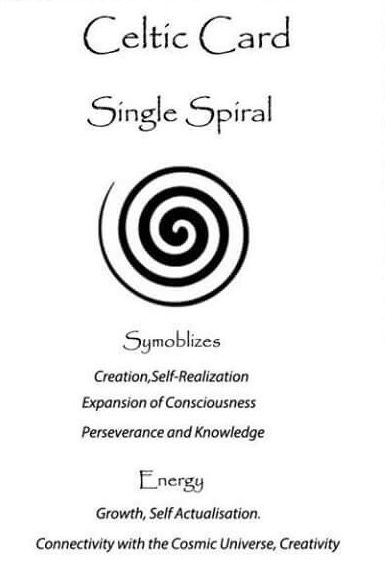
To answer people’s curiosity clearly, the tattoo is a single Celtic spiral. This is one of the most common and ancient symbols within Celtic culture. People from Ireland wear it. People from Scotland wear it. People across Great Britain wear it. It appears throughout Celtic history and across generations. There is nothing mysterious or hidden about it. It is widely used because it resonates with lived experience, cultural identity, and personal meaning, not because it signals a secret message.
The single spiral traditionally symbolizes creation, self-realization, and the expansion of consciousness. It represents growth from a central point outward, the idea that life begins within and continues to unfold as we learn, endure, and evolve. It is often associated with perseverance, knowledge, and understanding. Rather than representing attachment to another person, the spiral reflects an individual journey through life.
It is also deeply connected to creativity and energy. In Celtic symbolism, the single spiral represents creative force, personal expression, and the drive to build, imagine, and move forward. For many people, creativity isn’t limited to art alone; it’s part of how they live, work, and shape their path. The spiral reflects that ongoing process of becoming.
From my own perspective, this meaning resonates because it aligns with how Sam has spoken over the years about growth, learning, and being shaped by where he comes from, including his upbringing and the relationship he has acknowledged with his father. I’m not presenting this as a confirmed explanation or claiming insight into his private choices. It’s simply an interpretation of why this symbol makes sense on a human level, because for many people the spiral represents carrying your past with you while still moving forward.
I also want to be honest about why I care enough to write something like this. I genuinely enjoy learning about Sam as a person because he is one of the most interesting and intriguing men I’ve ever seen in the public eye. He has managed to move through Hollywood without falling into its traps, and he has done so with humility, groundedness, and a clear sense of self. That kind of character is rare.
I suppose that’s why I feel protective. People like Sam deserve peace of mind. They deserve space to live, grow, and exist without having their lives turned into fiction by strangers. They deserve the best from their fans, not people who spend their time inventing stories, pushing parasocial narratives, or treating a real human being like entertainment to dissect.
What the single spiral is not is a romantic symbol. Historically and culturally, it has never represented romantic attachment, relationships, marriage, or devotion to another person. Any attempt to turn it into that comes from modern projection, not Celtic tradition. Its meaning has always centered on life, growth, creativity, perseverance, and continuity.
This is why the symbol is so widely used. It doesn’t announce anything. It doesn’t signal a private message. It doesn’t require a dramatic backstory. It quietly reflects the journey of life itself, which is something people across Celtic cultures have connected with for centuries.
I also hope this helps put to rest some of the parasocial behavior and invented narratives that circulate among so-called fans. Real appreciation doesn’t require turning someone into a mystery to solve or a story to control. Sam is a human being, not a character under a microscope, and symbols don’t exist to fuel speculation.
Not everything needs a story invented around it. Not every detail needs to be examined until it becomes something it never was. Sometimes the most respectful thing we can do is allow something to simply be what it is.
In this case, the simplest explanation is also the most accurate. Sam has a tattoo. It is a single Celtic spiral, a symbol deeply rooted in Celtic culture and widely understood for what it represents. Anything beyond that belongs to Sam himself, should he ever choose to share it. And if he doesn’t, that should be enough.
Clarity doesn’t always come from zooming in further. Sometimes it comes from stepping back and letting things be exactly what they are.
There has been a growing narrative circulating lately that frames admiration for an artist as something that should be personally reciprocated, or that support only holds value if it results in access, acknowledgment, or emotional return. That framing deserves to be examined more carefully, because it misunderstands the nature of art, work, and human boundaries.
Support is not a transaction.
Watching a show, buying a ticket, supporting a project, or even meeting someone briefly does not create ownership, leverage, or entitlement. Art is shared intentionally, but it is not offered as a promise of intimacy or personal connection. When admiration is treated like a contract, disappointment becomes inevitable — because the expectation itself was never realistic.
The phrase “without us, he wouldn’t be where he is” is often used as though it establishes hierarchy or control. But creative careers are not sustained by audiences alone. They are built on discipline, longevity, collaboration, sacrifice, and a long-term commitment to craft. Support matters — but it does not grant authority over a person’s time, privacy, or emotional availability.
Another important truth often overlooked is that none of us truly know someone we haven’t built a real, private relationship with. A moment at a stage door, a brief exchange, or a public-facing interaction does not equal familiarity or understanding. It is a snapshot, not a bond.
Public figures are still people. They are not emotional vending machines, reward systems, or extensions of fan identity. They are allowed limits. They are allowed distance. They are allowed privacy — without that being interpreted as indifference or ingratitude. Expecting otherwise creates an uneven dynamic that was never healthy to begin with.
This is where nuance matters.
Sam Heughan has consistently shown himself to be someone with a big heart — through his work ethic, generosity of spirit, respect for collaborators, and long-standing commitment to causes beyond himself. That does not mean he owes personal access. It means his character is reflected in how he conducts himself, not in how available he makes himself to strangers.
There is an important difference between warmth and accessibility.
In Hollywood, it is common to see celebrity culture built on illusion, distance, or constant performance. Some figures rely on mystique. Others on relentless visibility. What sets Sam apart is not perfection, but groundedness — a steadiness and humility that keeps the work central and the boundaries intact.
Having a big heart does not mean having no boundaries.
Kindness does not mean obligation.
Respect does not require proximity.
Confusing these things is where frustration begins.
And this is where the phrase “taking a step back” deserves to be questioned.
A step back from what, exactly?
Often, it isn’t a step back from admiration or support. It’s a step back from unmet expectations. From imagined closeness. From the belief that attention given should be returned in kind. In those cases, the step back is not about balance — it’s about confronting the limits of a self-centered narrative.
When someone frames their departure as stepping back “for themselves,” it’s worth asking whether they are actually stepping back from the work — or from the idea that they should be centered within someone else’s life or career.
True perspective doesn’t come from withdrawing in resentment. It comes from releasing the assumption that proximity equals importance.
This is also where the idea of “focusing on ourselves” can become distorted.
Focusing on ourselves is not inherently wrong. It can be grounding and necessary. But when self-focus is rooted in comparison, resentment, or the belief that something is owed in return, it stops being growth and becomes self-centeredness. Reflection turns into justification. Boundaries turn into superiority. Self-care becomes entitlement.
That is when people risk becoming the worst version of themselves — not because they chose themselves, but because ego replaced empathy.
True self-focus is rooted in accountability, balance, and self-respect. It does not require diminishing others or stripping them of their humanity. It does not rewrite reality to soothe disappointment. It allows appreciation without expectation and admiration without ownership.
At its core, this conversation is not about disengagement.
It is about perspective — recognizing where admiration ends and entitlement begins, and choosing not to cross that line. It is about honoring the work without demanding access, and respecting the human being without projecting expectations onto them.
Sometimes distance exists.
Sometimes engagement exists.
And sometimes the healthiest stance is clarity — choosing respect over resentment, and substance over
There is a reason Sam Heughan continues to resonate with people across the world, and it has very little to do with rumor, speculation, or online noise. His career has been built deliberately—through discipline, consistency, and an unwavering respect for storytelling. Long before algorithms and headlines, there was craft. Long before attention, there was work.
When distractions are stripped away, what remains is an actor and creator who has devoted years to honing his skills, choosing meaningful projects, and committing fully to the roles and stories he helps bring to life. That dedication is the foundation of his longevity, and it is where the focus belongs.
Focusing on his work is not about ignoring curiosity or shutting down conversation. It is about choosing substance over spectacle. Careers like his are not sustained by gossip. They endure because of preparation, creative risk, and a long-term vision rooted in integrity. When attention drifts toward speculation or manufactured narratives, it pulls focus away from the very foundation of his success. Returning the conversation to the work is not avoidance—it is alignment with the values that have consistently defined his career.
This focus matters beyond professional optics. It matters because he is not just an artist—he is a human being. Keeping the spotlight on craft and projects helps protect peace of mind, which is essential for creativity to thrive. Artists create best when their mental and emotional space is respected. Constant intrusion, speculation, and noise erode that space and turn admiration into pressure.
For genuine fans, this approach creates a healthier and more meaningful connection. It shifts admiration away from entitlement and toward appreciation. It builds a fandom grounded in respect, curiosity about the work, and shared love for storytelling rather than fixation about his personal life. That kind of connection is sustainable and fulfilling for everyone involved.
Being honest also means acknowledging what actively pulls attention away from the work. Accounts that rely on speculation, manipulated imagery, or repeated insinuation—such as predux on Tumblr—do not contribute to thoughtful or meaningful discussion about projects or craft. These spaces thrive on provocation, not truth. And in the online world, engagement of any kind is currency. Every reblog, comment, argument, or attempt to “correct” still fuels the same cycle.
Ignoring these accounts is not denial or weakness. It is strategy. Silence removes oxygen. When fans stop engaging, those narratives lose momentum, and attention naturally shifts back toward conversations that are grounded, respectful, and constructive.
Encouraging others to stay away from this kind of noise does not require confrontation or public call-outs. Culture shifts through patterns, not arguments. Gentle redirection is far more effective. When speculation appears, steering the conversation back toward performances, projects, or interviews quietly resets the tone. Expressing interest in the work reinforces what deserves attention without escalating conflict.
Amplifying what matters is equally powerful. Algorithms follow behavior. When fans consistently engage with project announcements, interviews about craft, thoughtful reviews, and behind-the-scenes insights, those topics rise to the surface. Silence weakens noise. Engagement strengthens substance. Over time, this reshapes what dominates feeds, searches, and conversations.
If the projects are meant to be the talk, then they must be treated as such—shared, discussed, and appreciated for the work they represent. That is how narratives are reframed and preserved.
I encourage those on Instagram, Tumblr, Threads, Facebook, and even X to give this same gift of focus by consciously staying clear of unverified sources about his personal life. Not every account is rooted in truth, and not every narrative deserves attention. Choosing where information comes from—and whether it is engaged with at all—matters more than ever.
Privacy is becoming lost at an alarming pace in this day and age, especially for public figures. The erosion of personal boundaries has become normalized, often disguised as curiosity or fandom. But admiration does not justify intrusion. So much is already given through work, discipline, and creativity. The least that should be protected is the right to privacy without it being dissected, distorted, or turned into entertainment.
Protecting that privacy does not diminish admiration—it strengthens it. When fans choose restraint, they send a clear message: that the work is enough, that the craft is what truly matters, and that respect is not optional. By refusing to engage with unverified claims or invasive narratives about his personal life, space is preserved for artistry—not conjecture—to remain at the center.
Tone matters as well. Fans shape culture whether they intend to or not. A fandom centered on respect, restraint, and curiosity attracts thoughtful voices and endures beyond trends and viral moments. That kind of culture does not happen accidentally—it is built through intentional choices made every day.
And especially at this time of year, there is a meaningful way to express those choices.
You know what we can do for Sam Heughan this Christmas? We can give him the gift of focus. By choosing to center conversations on work—performances, projects, and creative journey—we help protect what allows creativity to continue in the first place: peace of mind.
That means consciously refraining from gossip, speculation, and unnecessary noise about his personal life. Not because anyone is told to, but because respect is intentional.
When we focus on the work, we honor the artist.
When we protect the space around the work, we protect the person.
It is not a loud gift.
It does not trend.
But it lasts.
And that is how he is best celebrated—not just at Christmas, but every single day.
It is shaped quietly, through decisions that are often invisible to the public but decisive to the work itself.
When looking at Sam Heughan’s career, what becomes clear is that his path has not been defined by chasing attention or reacting to trends. Instead, his work reflects a deliberate shaping of direction—one guided by curiosity, discipline, and a long view of what it means to build something lasting.
Early Foundations: Commitment to Craft
Every direction begins with foundation.
From the outset, there was a clear emphasis on learning the craft fully—on understanding character, language, physicality, and emotional restraint. Rather than relying on surface appeal, the work demonstrated a respect for preparation and immersion. This approach established an early pattern: roles were not chosen solely for visibility, but for what they required from the actor.
That foundation made later choices possible. Craft creates freedom.
Using Success as Leverage, Not a Destination
Breakthrough moments can either narrow a career or expand it.
Rather than allowing success to dictate repetition, Sam used it as leverage—to explore different forms of work rather than replicate a single formula. This meant balancing visibility with risk: continuing in familiar territory while deliberately stepping into projects that demanded different skills, tones, and creative muscles.
Direction, in this case, was shaped not by what worked once, but by what could still be learned.
Expanding Beyond Acting with Purpose
The move into writing and making was not a departure from acting—it was an extension of the same values.
Writing allowed for reflection and authorship. It offered a way to shape narrative directly rather than interpret it secondhand. Making, particularly within a cultural and traditional context, reflected patience, heritage, and respect for process. These pursuits were not distractions; they reinforced the same principles that guided performance: preparation, discipline, and care.
Each expansion was chosen because it aligned, not because it diversified for appearance’s sake.
Choosing Projects That Speak to Each Other
Over time, a pattern emerged.
The work began to form a conversation with itself—roles that explored identity, responsibility, resilience, and place; creative projects rooted in tradition and storytelling; choices that favored depth over novelty. Even when the form changed, the values did not.
This is how direction becomes visible: when projects begin to echo one another thematically, rather than compete for attention.
Resisting the Pressure to Over-Explain
Another defining aspect of direction is restraint.
Not every choice is explained publicly. Not every decision is framed for consumption. Allowing the work to stand without constant interpretation requires confidence—confidence in the audience, and confidence in the coherence of the work itself.
This restraint protects the direction. It prevents reaction from replacing intention.
Letting Time Confirm the Path
Direction reveals itself most clearly in hindsight.
When enough work accumulates, patterns become undeniable. Consistency appears—not as sameness, but as alignment. The work begins to feel deliberate even to those encountering it piece by piece.
What emerges is not a brand, but a body of work shaped by repeated, thoughtful choice.
Closing Reflection
Direction is not declared.
It is demonstrated.
Through steady commitment to craft, selective risk, and creative independence, Sam Heughan has shaped a path that feels cohesive rather than performative. The work does not rely on explanation to make sense; it relies on time.
And time, when allowed to do its work, reveals intention more clearly than noise ever could.
In a world where information moves quickly and attention shifts even faster, conversations can drift away from what actually matters. Speculation often rises louder than substance, and curiosity can begin to eclipse contribution. But when I slow down and look at what truly endures, I keep returning to the same place: the work itself.
Work is where intention reveals itself. It’s where discipline, preparation, and care accumulate over time. Unlike rumor or passing narrative, real work carries weight. It remains visible long after the noise fades. And when we allow the work to lead the conversation, much of the surrounding distraction loses its urgency.
Sam Heughan’s career has always reflected that kind of intention. Rather than building relevance through constant personal exposure, he has built a body of work rooted in craft. His choices suggest a long view—one shaped by patience, curiosity, and respect for storytelling rather than the need to stay perpetually visible.
That distinction matters, especially now.
Craft Built on Consistency
One of the most telling things about Sam’s work is its consistency. Not sameness—but steadiness. There’s a clear throughline of commitment to preparation, character, and emotional truth. Whether portraying complex roles, writing, or engaging in creative projects beyond acting, the approach remains grounded in effort rather than performance for attention.
That kind of consistency doesn’t come from chasing trends. It comes from understanding that craft is something you return to again and again, even when no one is watching. It’s built in rehearsal rooms, quiet research, long hours, and a willingness to keep learning.
That process doesn’t require a public audience.
It requires discipline.
What the Work Gives to People
Good work does more than entertain. It meets people where they are. It offers escape when life feels heavy, reflection when emotions are complex, and connection when isolation creeps in. Stories have a way of arriving at exactly the right moment for someone, even when the creator never knows it happened.
Sam’s work has done that for many people. Through characters that feel layered and human, through storytelling that honors place and culture, and through creative choices that prioritize meaning over spectacle, the impact is tangible. People don’t connect because they know his private life. They connect because the work resonates with their own experiences.
That is where the real relationship exists: between the work and the audience.
Privacy as a Foundation, Not a Strategy
There is a persistent narrative online that suggests when actors or actresses keep parts of their lives private, they are manipulating fans or withholding something they owe. This framing misses the reality of what privacy actually provides.
Privacy is not a tactic.
It is a foundation.
In an industry that has a long history of exploiting people emotionally and mentally, boundaries are often the only way to remain whole. Protecting parts of one’s life allows the work to continue without being distorted by constant intrusion. It preserves clarity, focus, and emotional balance.
Sam’s decision to keep his private life out of public consumption has never felt evasive. It feels deliberate. And that deliberateness has allowed him to sustain a career built on substance rather than exposure.
Protecting the person protects the work.
And protecting the work protects the audience’s experience of it.
Discernment in an Age of Unverified Narratives
As long-running projects reach their final chapters and familiar stories come to a close, attention often searches for somewhere else to land. When the rhythm of new episodes or ongoing narratives slows, speculation can rush in to fill the space.
This is where unverified accounts thrive.
These narratives often rely on repetition, emotional language, and urgency rather than evidence. They present assumption as insight and conjecture as concern. And when shared frequently enough, they can begin to feel credible—even when they are not.
This is not curiosity serving understanding.
This is distraction serving noise.
Discernment becomes essential here. Not every source is reliable. Not every claim deserves attention. And not every story being told is rooted in fact.
Choosing to pause, question, and redirect attention back to the work is not avoidance. It is responsibility.
Gratitude Without Entitlement
Sam has consistently expressed gratitude for those who support his work. No meaningful career exists without an audience, and acknowledgment of that support is sincere. Fans matter. Engagement matters. Connection matters.
But gratitude does not create obligation.
Supporting someone’s work does not grant ownership of their life. Admiration does not entitle access. And being a fan does not come with the right to personal explanations that were never offered.
At times, admiration quietly shifts into expectation, and expectation into entitlement. When that happens, perspective is lost. The artist becomes a projection rather than a person, and curiosity turns into demand.
That shift diminishes the very thing people claim to value.
Returning to What Endures
What lasts in any meaningful career is not speculation or access. It is contribution. It is the accumulation of work created with care and integrity. It is the way that work continues to reach people—sometimes years later—in ways that feel personal, grounding, and real.
Focusing on Sam’s craft is not avoidance.
It is respect.
It is choosing to value what he creates over what others invent. It is recognizing that impact does not require disclosure, and connection does not require entitlement.
A Conscious Choice
I believe we are better served—individually and collectively—when we let the work lead. When we prioritize artistry over access, discernment over distraction, and humanity over speculation.
We don’t need to fill every silence.
We don’t need to answer every question.
And we don’t need to confuse curiosity with understanding.
The work is already doing what it’s meant to do.
It is connecting. It is contributing. It is helping people.
There is a difference between performance and passion.
One seeks attention. The other seeks connection.
What has always stood out to me about Sam Heughan is not volume or visibility, but intention. A steady through-line runs through everything he does — an unmistakable love of craft, and a genuine enjoyment in sharing that craft with others.
When we slow down and look at the work itself, a far clearer story emerges.
The Writer: Reflection as Craft
Writing is often misunderstood as output. In truth, it is process — one rooted in reflection, patience, and honesty. Writers do not share simply to be seen; they share to be understood.
Storytelling requires vulnerability. It asks the writer to trust the reader, and the reader to meet the work with curiosity rather than assumption. It is an act of offering something lived, shaped, and considered.
That sincerity — the willingness to reflect, to remember, to give form to experience — is where meaningful work begins.
The Maker: Pride in Process
To make something well takes time. It requires respect for tradition, attention to detail, and a willingness to learn slowly.
In Scotland especially, making is inseparable from sharing. Hospitality is cultural. What is crafted is meant to be poured, tasted, discussed, and enjoyed together.
Pride in process is not bravado. It is care.
And care shows — in patience, in presentation, and in the pleasure of inviting others into the experience.
The Actor: Discipline Over Display
The strongest performances rarely announce themselves. They live in nuance, restraint, and the discipline of disappearing into character rather than standing above it.
Longevity in acting does not come from chasing attention. It comes from choosing work that stretches, challenges, and respects story. From returning again and again to craft rather than spectacle.
The work lasts because it is rooted in intention, not noise.
The Through-Line: Sharing
When you step back and look at the full body of work — writing, acting, making — a single pattern becomes clear.
This is not self-promotion.
It is invitation.
Sharing stories.
Sharing culture.
Sharing what has been learned, made, and loved.
An open hand, not a raised voice.
The work is not asking to be admired.
It is asking to be shared.
Listening to the Work
We live in a world that rushes to interpret, label, and project. But craft reveals character over time, not in moments.
When we choose to listen — to observe what is consistently made and offered — clarity follows. The work speaks plainly when we allow it to.
And what it says, again and again, is this:
Making things well matters.
Sharing them generously matters.
The rest is noise.
Closing Reflection
The most enduring stories are built slowly — through care, consistency, and heart. When we focus on the work rather than the commentary around it, we return to what is real.






 Deep Thinking