In the digital age, the way we search for information shapes not only what we believe, but how we interpret and respond to what we see. This becomes especially clear when rumors circulate about public figures. Many people turn to search engines or AI tools hoping to find clarity, yet those tools do not function the same way—and misunderstanding that difference can unintentionally fuel misinformation and unnecessary concern.
This discussion is not about rumor itself. It is about process—how information is surfaced, analyzed, and either escalated or grounded.
How Search Engines Frame Rumors
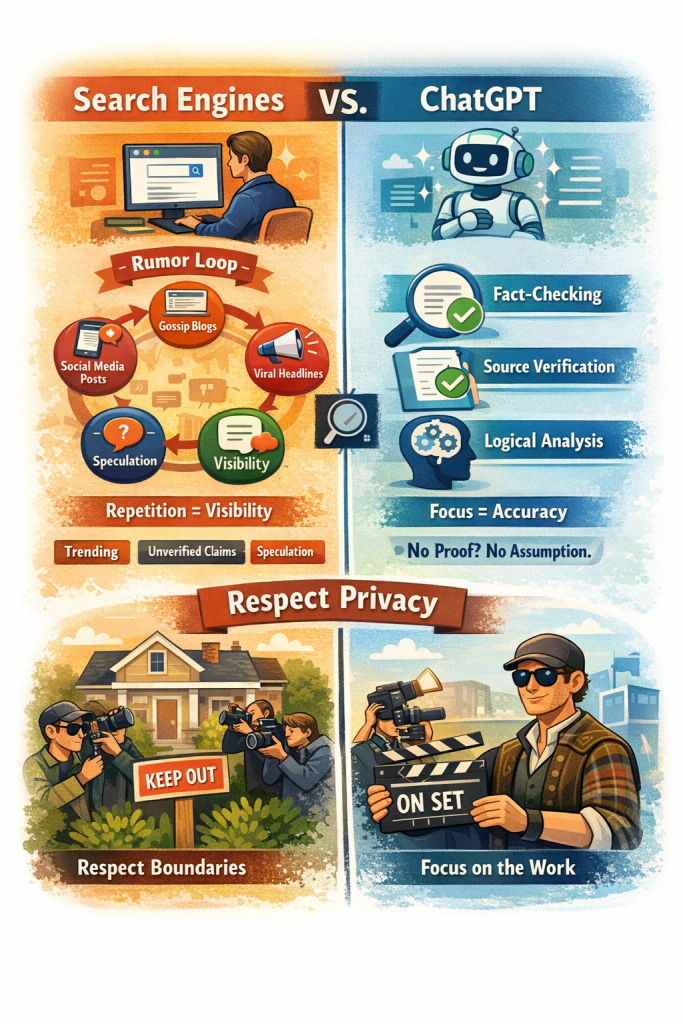
Search engines are built to collect, index, and rank content that already exists online. When someone searches a name alongside a rumor or narrative, the engine does not evaluate whether the claim is accurate. It simply gathers content where those terms appear together and ranks it based on relevance, engagement, and repetition.
As a result, search results may include social media posts, blogs referencing one another, screenshots without context, or commentary built on assumption rather than confirmation. When similar narratives appear repeatedly, they can feel validated simply because they are visible.
Search engines answer one question:
“What content exists online related to this query?”
They do not determine whether that content is verified.
How Repetition Becomes Perceived Credibility
This is where rumor loops take hold. One speculative post is shared. Others repeat or paraphrase it. Blogs echo the same ideas. Search engines index the repetition. Over time, visibility creates the illusion of consensus—even though no proof has ever been introduced.
The system rewards repetition, not accuracy. And for people who are trying to be careful and informed, this can be deeply misleading.
Where Real Concern Can Develop
Repeated exposure to the same unverified narrative can trigger genuine concern—not because someone believes gossip, but because repetition raises questions. People may worry about safety, privacy, or whether someone is being misrepresented or placed under scrutiny due to speculation spreading without restraint.
Search engines do not offer reassurance or clarification. They do not explain rumor dynamics. They simply present more content, which can unintentionally escalate concern rather than resolve it.
How ChatGPT Approaches the Same Information
ChatGPT operates from a different framework. It does not compile posts or rank narratives by popularity. Instead, it evaluates whether there is verifiable public information supporting a claim.
When a rumor is presented, ChatGPT looks for confirmation from accountable sources, checks logical consistency, examines timelines, and recognizes common misinformation patterns such as anonymous sourcing or recycled narratives. If no verified information exists, that is stated clearly.
Rather than escalating concern, this approach slows the process down and separates emotional reaction from factual conclusion.
Visibility Is Not Verification
One of the most important distinctions to understand is that visibility does not equal truth. Photos, screenshots, and anecdotes can circulate widely and still lack context or confirmation.
Search engines make information easy to find.
ChatGPT highlights what is missing.
That difference alone can prevent assumption from replacing evidence.
How I Personally Use Both Tools
I use both search engines and ChatGPT intentionally and for different reasons. I am a very intelligent person, and being autistic gives me a strong interest in patterns, systems, and how technology is used—especially in situations like this. I find it genuinely fascinating how information spreads, how tools shape perception, and how repetition can influence belief.
At the same time, I understand that both tools need to be taken with a grain of salt. Search engines can amplify noise. AI tools can analyze patterns—but neither should replace critical thinking. Technology is powerful, but it is not infallible, and discernment is always necessary.
Using these tools thoughtfully allows me to stay informed without jumping to conclusions, and curious without being pulled into speculation.
Why Respect and Boundaries Matter
As I have said many times before, Sam Heughan is a man I deeply and highly respect. He has not fallen into the common traps of Hollywood, and he has been very deliberate about maintaining his privacy. That choice alone should tell people everything they need to know.
Someone who values privacy to that degree would never expose their private life to the public, nor invite speculation or narratives about it. People should already understand this by now.
He deserves to have people in his corner—people who respect his boundaries, his humanity, and his right to a private life. The focus should always be on his work, his craft, and his contributions—not on speculation about what he has intentionally chosen to keep personal.
Using Tools Responsibly
Search engines remain useful for finding official statements, interviews, and primary sources. They are starting points, not conclusions.
ChatGPT complements that by helping evaluate credibility, logic, and confirmation. Used together, they encourage restraint, clarity, and responsible interpretation rather than rumor amplification.
Sometimes the most accurate conclusion is simply:
There is no verified information confirming this.
That answer is not dismissive.
It is responsible.
Final Reflection
Search engines show us what is being said.
ChatGPT helps us understand what can be trusted.
Using Sam Heughan as an example highlights an essential truth: repetition is not proof. In a digital world driven by speed and visibility, choosing to slow down, respect boundaries, and focus on meaningful work rather than private lives is not only intelligent—it is humane.
 Deep Thinking