There’s been a lot of conversation recently about a new advertisement for Sassenach Spirits whisky, and some confusion around what was actually being said. I want to take a moment to walk through it clearly, because when you look at the full message, it’s actually very straightforward.
The advertisement itself was beautifully done and genuinely intelligent—it set the mood for whisky right from the beginning. There’s a warmth and playfulness to it that immediately draws you in, and you can feel the intention behind it. It doesn’t feel random or thrown together—it feels structured and purposeful.
It opens with:
“Sam Heughan is coming home with you.”
That line isn’t meant to be literal—it’s a creative way of saying the whisky is coming home with you. It’s inviting, slightly cheeky, and designed to catch attention while setting the tone for everything that follows.
Then comes:
“man? taken. whisky? available.”
“man? taken” → this is not a literal or definitive statement about his personal life. It’s using familiar language people recognize, but in a symbolic, advertising way. What it does is create a boundary. It separates who he is as a person from what is being presented, making it clear he is not something for the public to interpret personally, access, or turn into something beyond the ad. It closes that door in a subtle, controlled way.
“whisky? available” → this is the actual message. This is what is being offered. The whisky is what people can purchase, take home, and experience. It brings the focus directly back to the product and the work behind it.
Put together, the structure is intentional:
one removes the personal angle, the other defines what is actually available.
It’s a contrast that guides attention. It briefly introduces something that sounds personal, then immediately redirects it to something tangible and real—the whisky.
How this kind of marketing works
Good marketing is built on structure, not randomness.
It typically follows a pattern:
it grabs attention
it creates a moment of curiosity
then it redirects that attention to the product
That’s exactly what is happening here.
The ad uses language that sounds personal because that’s what naturally draws people in. But it doesn’t stay there. It quickly shifts and makes the message clear—the whisky is what is available.
There is no hidden meaning behind it. No coded message. No personal revelation. It’s a deliberate use of contrast and wordplay to guide the viewer from curiosity to clarity.
From what has been consistently shown over time, this approach fits. The focus has always been on the work, the brand, and what is being created—not on using advertisements as a way to communicate personal information.
Why it gets misunderstood
When one phrase is taken on its own, without the rest of the message, the meaning can easily change.
There’s a pattern where people interpret things through a personal lens, especially when there is a strong connection or interest. In those moments, small details can feel like they carry more meaning than they actually do.
But not everything is meant to be interpreted beyond what is presented.
In this case, the meaning is already complete when you look at the full message. It is not about someone’s personal life—it is about the product being offered.
Taking a step back and looking at everything together removes the confusion.
What stands out to me
What stands out is the balance. The ad keeps a light, engaging tone while still maintaining a clear distinction between public work and private life.
It shows awareness in how attention works, and how easily it can shift. And instead of ignoring that, it uses it in a controlled way to bring the focus back where it belongs.
And I won’t lie… it even has me wanting whisky now 😂😂😂😂
Final thought
When you take it all in, it’s simple:
he’s not what’s being offered—the whisky is.
Sometimes the message is already right in front of us.
It just requires looking at the whole instead of one part.
It’s hard for me not to be joyful—that’s simply who I am.
Even something as small as a butterfly passing by, or the quiet, intricate creation of a spider’s web, can stop me in my tracks. There’s a kind of beauty in those moments that feels alive to me. I know not everyone experiences the world that way, and I understand it can seem different—but I would never apologize for it.
That sense of wonder, that instinct to pause, observe, and feel… it’s part of how I move through life.
And it’s also why I get excited over things—especially when it comes to meaningful work.
Lately, a question has come up more than once: am I part of Sam Heughan’s team, or do I know him personally?
The answer is simple—I’m not, and I don’t.
I’m just me.
But I understand why people might think that.
The way I speak about Sam Heughan, the way I reflect on his work, and the consistency in how I express what I see—it can come across as something more. It can sound like there’s access behind it, like there’s a connection people don’t see.
But there isn’t.
What I share doesn’t come from access. It doesn’t come from knowing anything personal about Sam Heughan. It doesn’t come from being connected to his team in any way.
It comes from paying attention.
I pay attention to what he says—not just the words, but the meaning behind them. I pay attention to how he carries himself over time, not just in one moment. I pay attention to the intention behind his work—the effort, the consistency, and the care that he brings into what he does.
Because when someone shows up in the world with purpose, when they approach their work with thoughtfulness and intention, that says something.
And that’s something I respect deeply about Sam Heughan.
One of the things that has always stood out to me is the way he speaks about his homeland. There’s a depth of love there that feels steady and grounded—not performative, not exaggerated, just real.
It’s the kind of love that doesn’t need to prove itself.
And honestly, that kind of connection—to where you come from, to what shaped you—is a beautiful quality. It’s something I wish more people allowed themselves to express openly.
The way I see things comes from my own lens—my mind, my heart, and my spirit working together.
My mind is always observing, always trying to understand patterns, meaning, and intention. My heart feels things deeply—sometimes before I even have the language to explain it. And my spirit recognizes when something feels genuine.
So when I share something about Sam Heughan or his work, it’s not impulsive.
I sit with it. I reflect on it. I let it settle.
And when something feels meaningful, I express it as honestly as I can.
I think sometimes when people see that level of reflection, they assume there has to be something more behind it.
That there must be access. That there must be a personal connection.
But there isn’t.
I don’t know Sam Heughan personally.
I simply respect him—for his work, for the intention behind it, and for the way he seems to carry himself in the world.
And that is enough.
Because respect doesn’t require access. Understanding doesn’t require proximity. And appreciation doesn’t need to cross boundaries to be real.
But somewhere along the way, that line has become blurred.
We live in a time where access feels expected. Where people believe that if someone shares parts of their life, they are entitled to the rest of it. Where curiosity can turn into assumption, and assumption can forget that there is a real person at the center of it all.
And that’s where I feel the need to speak gently, but clearly.
Sam Heughan does not owe anyone access to his private life.
Not the quiet moments. Not the personal relationships. Not the parts of himself he chooses to protect.
Respecting Sam Heughan means more than appreciating his work—it means honoring what he chooses not to share.
It means recognizing that he is a human being first, not just a role, not just a public image, not just someone to be analyzed or speculated about.
It means understanding that boundaries are not barriers—they are expressions of self-respect.
And if we truly admire him, then respecting those boundaries should come naturally.
Even if I were ever given the chance to connect with Sam Heughan, I would keep that private. Not out of secrecy, but out of respect. Because who someone chooses to have in their life is personal, and it deserves to be treated that way.
At the same time, I would be honest. I would share the same thoughts I express here, because I believe that kind of sincerity—spoken with care and without expectation—can be a meaningful gift.
At the end of the day, I’m not anything extraordinary.
I’m just someone who feels deeply, thinks deeply, and does my best to put those thoughts into words… even on the days when my mind is tired but still won’t stop observing, reflecting, and trying to understand.
And if there’s one thing I truly hope people take from this, it’s this:
Being a fan of Sam Heughan isn’t about having access.
It’s about having appreciation.
And the most meaningful kind of appreciation is the one that is rooted in respect, carried with kindness, and expressed with love—for his work, for his effort, and for the human being behind it all.
Supporting With Integrity: Why Boundaries and Truth Matter in Fandom
Over the last few weeks, I’ve watched the online space become louder again. Rumors, edited videos, speculation, and people claiming to have “inside information.” I’ve honestly been trying to stay away from all of it because that environment becomes toxic very quickly. It’s overwhelming, exhausting, and full of noise. It pulls people away from the work, the art, and the deeper reasons many of us became fans in the first place.
But sometimes silence allows misinformation to grow. And when that happens, it stops being harmless. It begins to affect real people. This is why I felt the need to speak up.
What many people don’t realize is how the professional world around actors like Sam Heughan actually works. The teams that support him—publicists, agents, managers, legal teams, and production professionals—are not there to create drama or fuel speculation. Their entire purpose is to protect his career, his reputation, his projects, and his privacy.
Most people working in the entertainment industry sign strict legal contracts called Non-Disclosure Agreements, or NDAs. These agreements legally require them to keep private information confidential. This includes personal details, private conversations, future projects, and anything that has not been publicly shared.
Breaking an NDA is not a small mistake. It carries very serious consequences.
If someone leaks private information, they can face lawsuits, financial penalties, and immediate termination. Even more significant, they risk being permanently shut out of the industry. Entertainment is a smaller world than most people think. Trust and reputation are everything. Once confidentiality is broken, it spreads quickly, and that person may never be trusted again.
This is why the idea that someone “on the inside” would casually share personal details online simply does not make sense. It would mean risking years of education, training, and professional relationships for temporary attention. Real professionals do not do that. Their job is to reduce speculation, not create it.
So when people online claim to have inside access or secret information, it rarely aligns with how this industry truly operates. More often, it comes from fans who want to feel closer, accounts seeking attention or followers, or individuals who build communities around speculation. But none of this is grounded in reality.
And this matters.
Rumors are not harmless entertainment. They can affect mental health, working relationships, and the environment surrounding creative projects. They shift focus away from storytelling and toward personal invasion. They create pressure and misunderstanding, and they can change the tone of a fandom in ways that are not healthy or sustainable.
Both Sam and many actors in similar positions have spoken about the importance of boundaries and respect. They have asked fans to focus on the craft, the stories, and the work. That request is not about secrecy. It is about creating a healthy relationship between artists and the people who support them.
For me, supporting Sam has always meant something deeper.
There is also a very personal reason this matters so much to me.
Sam Heughan means a great deal to me as my creative muse. Over the last few years, his work and dedication have helped me reconnect with my own creativity, storytelling, and sense of purpose. As an autistic adult, I often experience the world in layers—through details, emotions, and sensory moments that others may overlook. His work brought me back to creativity, storytelling, and the quiet beauty of seeing life more deeply.
I have always been someone who stands up for fairness and truth. It’s simply part of who I am. I believe in kindness, integrity, and protecting people from being misunderstood or unfairly judged. So when I see any situation where speculation or misinformation begins to overshadow someone’s work or character, I feel a responsibility to bring the focus back to what truly matters.
I will always speak up for respect and balance, especially when it comes to someone who has inspired so much growth and creativity in my life. Because he is so much more than just an actor. He is a human being who has used his platform to uplift others, encourage growth, and bring meaningful stories to life. That deserves respect. That deserves honor. And it deserves a fan community that reflects those same values.
For me, supporting him means protecting that space. It means choosing integrity over noise, and kindness over curiosity. It means remembering that behind every public figure is a real person who deserves dignity and peace.
Healthy fandom is not passive. It is intentional. It chooses truth over noise, respect over rumor, and boundaries over curiosity.
The strongest support we can give any artist is simple:
To trust what they choose to share.
To honor their privacy.
To celebrate their work.
And to remember that behind the public image is a human being who deserves peace.
That is the energy I choose to bring. And I hope more of us choose it too.
This man will always be my favorite, and he deserves so much more in life because of his incredible personality. He deserves peace of mind and a significant amount of his work should be the center around him.
Lately, I’ve been noticing something online that honestly makes me uncomfortable. I keep seeing people take photos of actors and public figures and immediately start assuming how they must be feeling. A neutral face suddenly means they’re sad. A serious expression becomes anger or stress. A quiet moment turns into a whole story about their mental state.
And the truth is, we simply don’t know.
From my point of view, this kind of behavior is not only inaccurate, it’s disrespectful. These are human beings, not puzzles to solve or experiments to analyze. A single photo is just one tiny moment in someone’s life. It doesn’t show what happened before that moment or what comes after. It doesn’t show their thoughts, their focus, or their reality.
What I’ve come to realize is that a lot of this comes from projection. People see their own emotions reflected back at them. If they feel lonely, they think the person in the photo looks lonely. If they feel anxious, they assume the person must be anxious too. It creates this illusion of connection, but it isn’t real understanding. It’s just filling in the blanks with personal feelings.
I also think people forget that actors are professionals. Their work takes discipline, focus, and emotional control. Sometimes a serious expression simply means they are concentrating. Sometimes they’re tired from long filming days, travel, or busy schedules. Sometimes they’re just thinking. Not every moment needs to be turned into a dramatic story.
Social media has made this worse. The more emotional or extreme the assumption, the more attention it gets. That encourages people to overanalyze body language and facial expressions like they’re detectives, even when they have no real information. Over time, it creates a culture where people forget there is a real person behind the image.
I strongly believe that no one owes the public access to their inner emotional world. Public figures share their work and their talent. That does not mean they have given up their privacy, their boundaries, or their humanity. Supporting someone should mean respecting those boundaries, not crossing them.
For me, real admiration is about focusing on their craft, their dedication, and the impact of what they create. It’s about celebrating their work and the joy they bring into people’s lives, not demanding access to every part of who they are.
If we want healthier fan communities, this mindset has to change. Kindness and emotional maturity matter, especially online. When we stop assuming and start respecting, we create safer and more positive spaces for everyone.
I would also really like to see social media platforms like Instagram, Threads, Facebook, and even Tumblr improve in this area. Social media should be a safe environment where people can enjoy content, connect, and support others without constant drama or speculation. These platforms have the ability to encourage healthier conversations, set stronger boundaries, and make it easier to filter out harmful behavior. That kind of environment would benefit not only public figures, but everyday people too.
So at the end of the day, if I see people spreading that kind of negativity or speculation about celebrities, I don’t hesitate to block and move on. I don’t want to give attention to behavior that crosses boundaries or disrespects someone’s humanity.
And honestly, I think we should all ask ourselves this: how would we feel if strangers analyzed us and put us under a microscope every single day? Most of us would find that exhausting and unfair. So why should it be acceptable just because someone is in the public eye?
To me, real support means allowing people the space to simply be human. Because admiration should never turn into entitlement, and respect should always come first.
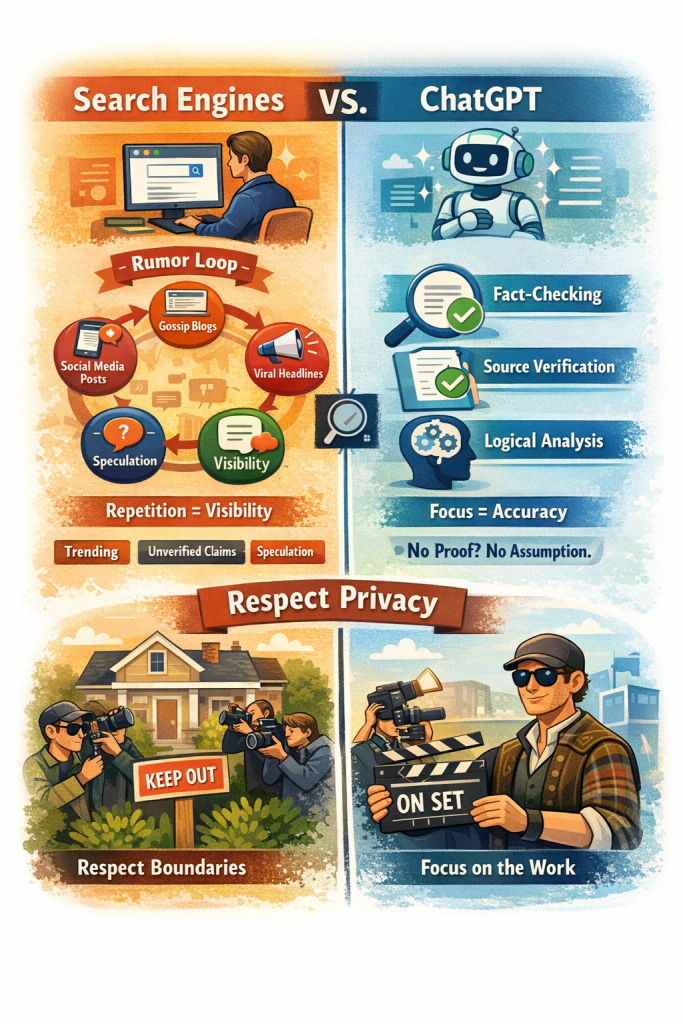
In the digital age, the way we search for information shapes not only what we believe, but how we interpret and respond to what we see. This becomes especially clear when rumors circulate about public figures. Many people turn to search engines or AI tools hoping to find clarity, yet those tools do not function the same way—and misunderstanding that difference can unintentionally fuel misinformation and unnecessary concern.
This discussion is not about rumor itself. It is about process—how information is surfaced, analyzed, and either escalated or grounded.
How Search Engines Frame Rumors
Search engines are built to collect, index, and rank content that already exists online. When someone searches a name alongside a rumor or narrative, the engine does not evaluate whether the claim is accurate. It simply gathers content where those terms appear together and ranks it based on relevance, engagement, and repetition.
As a result, search results may include social media posts, blogs referencing one another, screenshots without context, or commentary built on assumption rather than confirmation. When similar narratives appear repeatedly, they can feel validated simply because they are visible.
Search engines answer one question:
“What content exists online related to this query?”
They do not determine whether that content is verified.
How Repetition Becomes Perceived Credibility
This is where rumor loops take hold. One speculative post is shared. Others repeat or paraphrase it. Blogs echo the same ideas. Search engines index the repetition. Over time, visibility creates the illusion of consensus—even though no proof has ever been introduced.
The system rewards repetition, not accuracy. And for people who are trying to be careful and informed, this can be deeply misleading.
Where Real Concern Can Develop
Repeated exposure to the same unverified narrative can trigger genuine concern—not because someone believes gossip, but because repetition raises questions. People may worry about safety, privacy, or whether someone is being misrepresented or placed under scrutiny due to speculation spreading without restraint.
Search engines do not offer reassurance or clarification. They do not explain rumor dynamics. They simply present more content, which can unintentionally escalate concern rather than resolve it.
How ChatGPT Approaches the Same Information
ChatGPT operates from a different framework. It does not compile posts or rank narratives by popularity. Instead, it evaluates whether there is verifiable public information supporting a claim.
When a rumor is presented, ChatGPT looks for confirmation from accountable sources, checks logical consistency, examines timelines, and recognizes common misinformation patterns such as anonymous sourcing or recycled narratives. If no verified information exists, that is stated clearly.
Rather than escalating concern, this approach slows the process down and separates emotional reaction from factual conclusion.
Visibility Is Not Verification
One of the most important distinctions to understand is that visibility does not equal truth. Photos, screenshots, and anecdotes can circulate widely and still lack context or confirmation.
Search engines make information easy to find.
ChatGPT highlights what is missing.
That difference alone can prevent assumption from replacing evidence.
How I Personally Use Both Tools
I use both search engines and ChatGPT intentionally and for different reasons. I am a very intelligent person, and being autistic gives me a strong interest in patterns, systems, and how technology is used—especially in situations like this. I find it genuinely fascinating how information spreads, how tools shape perception, and how repetition can influence belief.
At the same time, I understand that both tools need to be taken with a grain of salt. Search engines can amplify noise. AI tools can analyze patterns—but neither should replace critical thinking. Technology is powerful, but it is not infallible, and discernment is always necessary.
Using these tools thoughtfully allows me to stay informed without jumping to conclusions, and curious without being pulled into speculation.
Why Respect and Boundaries Matter
As I have said many times before, Sam Heughan is a man I deeply and highly respect. He has not fallen into the common traps of Hollywood, and he has been very deliberate about maintaining his privacy. That choice alone should tell people everything they need to know.
Someone who values privacy to that degree would never expose their private life to the public, nor invite speculation or narratives about it. People should already understand this by now.
He deserves to have people in his corner—people who respect his boundaries, his humanity, and his right to a private life. The focus should always be on his work, his craft, and his contributions—not on speculation about what he has intentionally chosen to keep personal.
Using Tools Responsibly
Search engines remain useful for finding official statements, interviews, and primary sources. They are starting points, not conclusions.
ChatGPT complements that by helping evaluate credibility, logic, and confirmation. Used together, they encourage restraint, clarity, and responsible interpretation rather than rumor amplification.
Sometimes the most accurate conclusion is simply:
There is no verified information confirming this.
That answer is not dismissive.
It is responsible.
Final Reflection
Search engines show us what is being said.
ChatGPT helps us understand what can be trusted.
Using Sam Heughan as an example highlights an essential truth: repetition is not proof. In a digital world driven by speed and visibility, choosing to slow down, respect boundaries, and focus on meaningful work rather than private lives is not only intelligent—it is humane.
Every public figure eventually becomes the subject of microscopic scrutiny, and Sam is no exception. Recently, attention has fixated on a claim that he has a tattoo under his wrist. At first glance, it sounds trivial. In reality, it reveals something much deeper about how rumors form, why they stick, and how easily a person’s body becomes a canvas for other people’s assumptions.
This isn’t about whether tattoos are good or bad. It’s about truth, pattern recognition, and respect.
How the Rumor Attached Itself to Sam
The claim usually begins with a single photo or short clip from a public appearance—often a book signing or event where lighting is harsh and angles are unflattering. Someone notices a dark line, shadow, or irregularity near his wrist. The image is then zoomed in, cropped tightly, and reposted without its original context.
Once that happens, the conversation shifts from observation to interpretation. Instead of asking what the image actually shows, people begin asking what the “mark” means. That’s where speculation takes over.
Looking at Sam’s Public History
Sam has been photographed extensively over many years: press tours, interviews, red carpets, filming days, fan events, and candid moments. If there were a permanent tattoo under his wrist, it would appear consistently across time and settings.
It doesn’t.
In most clear, unedited images, his wrist appears completely normal. No repeated marking. No consistent shape. No permanence. Tattoos don’t behave selectively. They don’t show up for one photo and disappear for the next decade.
That inconsistency alone tells you everything you need to know.
Why Sam’s Wrist Can Look “Marked” in a Photo
There are many mundane reasons his wrist might look different in a single image:
Lighting can cast sharp shadows along tendons and veins, especially under stage lights or camera flashes.
Wrists have thin skin, so veins can appear darker depending on temperature, hydration, or muscle tension.
Temporary pen marks, wrist stamps, or makeup transfer are common during events.
Wardrobe tape or adhesive residue can leave faint lines.
Image compression, filters, or AI enhancement can introduce artificial contrast or lines that weren’t present in the original photo.
Old photos are often recycled, edited, or reposted with new narratives attached.
None of these equal a tattoo, yet all of them have been used to fuel this rumor.
Why Sam Becomes a Target for These Narratives
Sam is very deliberate about protecting his private life. He shares his work, his passions, and what he chooses—but he doesn’t offer unrestricted access to himself. That boundary makes some people uncomfortable.
When real information is unavailable by design, speculation rushes in to fill the space. A wrist becomes a clue. A shadow becomes a secret. The rumor isn’t about ink—it’s about control and curiosity colliding with privacy.
Confirmation Bias in Action
Once someone decides the tattoo exists, every image becomes “evidence.” Shadows are proof. Absence becomes suspicious. Clear photos showing nothing are dismissed. This is classic confirmation bias, and it’s amplified by social media algorithms that reward repetition over accuracy.
At that point, the discussion stops being about Sam and starts being about defending a belief.
The Line That Shouldn’t Be Crossed
Sam’s body is not a puzzle for strangers to solve. Being visible does not mean being owned. Scrutinizing wrists, hands, or physical details for hidden meaning crosses from interest into entitlement.
Respecting boundaries isn’t passive—it’s a conscious choice.
What People Miss the Most
If Sam had a wrist tattoo, it wouldn’t require detective work, zoom tools, or rumor accounts to confirm it. Facts don’t need help surviving. They don’t rely on blurry screenshots or secondhand whispers.
The need to keep proving something is often the strongest sign that it isn’t real.
The Reality
There is no confirmed tattoo under Sam’s wrist. What exists instead is a familiar pattern: assumption turns into repetition, repetition turns into belief, and belief turns into a narrative that overshadows reality.
Sam deserves to be seen clearly—not through speculation, but through truth.
I came across it the way many people do online — gradually, through repetition. The same claim kept appearing across fandom spaces, first on Tumblr and later echoed on Threads through screenshots and reblogs. At first, I assumed it was simply another fan account sharing personal interpretation.
What caught my attention wasn’t the claim itself — it was how often the exact same narrative resurfaced, even after people had already asked reasonable questions about it.
Different accounts repeated the story, but the language, framing, and conclusions were strikingly similar. Over time, it became clear that many of these discussions traced back to the same source.
That’s when I started paying closer attention.
The Account Where the Narrative Originated
As I observed the repetition, I began tracing where the story consistently led back to. The earliest and most persistent source was a Tumblr account operating under the handle p-redux.
I’m naming the account here for source transparency, not to target or harass an individual. Identifying the origin of a widely circulated claim is a basic part of responsible research — especially when that claim involves a real person’s private life.
While other accounts reposted or paraphrased the narrative, the same interpretations, images, and assumptions consistently traced back to this one source. When interest faded, the story would often reappear — slightly reframed, but emotionally unchanged.
Credible information spreads through independent confirmation.
This narrative spread through repetition of a single source.
That distinction matters.
The Original Story — and How I Watched It Evolve
When I first encountered the narrative, it was relatively simple and contained. The original story centered on one core claim, presented as if it were already settled — despite the absence of confirmation from official sources, reputable media, or anyone directly involved.
At that stage, the story relied heavily on interpretation:
select photos
brief public moments
assumptions stitched together as conclusions
Speculation was presented as certainty, with no clear distinction between opinion and fact.
What stood out to me over time was that this original version did not remain consistent.
As questions arose and skepticism grew, the narrative began to change. Timelines subtly shifted. New explanations appeared. Details were adjusted — not to clarify evidence, but to keep the story alive. When one version lost traction, another quietly replaced it.
The emotional conclusion stayed the same.
The surrounding details evolved.
Credible stories stabilize as facts emerge.
This one morphed.
Watching that evolution was a turning point. It showed that the narrative wasn’t guided by evidence — it was guided by persistence.
From Observation to Research
At first, I didn’t interact. I didn’t comment or challenge. I simply observed.
What became clear fairly quickly was that speculation was not framed as speculation. Interpretation was framed as fact — without sourcing, confirmation, or accountability.
Several red flags appeared:
claims stated with certainty
repeated reuse of the same visuals
assumptions treated as conclusions
an authoritative tone without transparency
Reliable information typically welcomes scrutiny.
This narrative resisted it.
What My Research Revealed
As I continued tracking the story, consistent patterns emerged.
1. The narrative never stabilized
Details changed over time. Explanations evolved. New angles appeared when old ones lost momentum. Instead of becoming clearer, the story became more fluid.
2. Visuals were used without verification
Photos and videos were repeatedly used as “evidence,” yet they were:
taken from public settings
cropped or zoomed
stripped of original context
interpreted rather than confirmed
In some cases, the same images were reused to support different versions of the story — immediately weakening their credibility.
Images alone are not proof.
3. The story functioned in loops
I documented a repeating cycle:
A claim gains attention
Interest fades
A new variation appears
The cycle restarts
Nothing is ever confirmed.
Nothing is ever resolved.
Truth does not behave this way.
How Photos Become Stripped of Context
Because visuals played such a large role in reinforcing this narrative, it’s important to explain how a real photo can still be misleading.
A photograph captures a moment — not the full story. Context includes where it was taken, when it was taken, who else was present, why the moment occurred, and how it fits into a larger event. When that context is removed, meaning changes.
This happens through:
Cropping, which removes surroundings and other people
Missing dates, allowing older images to appear recent
Unclear locations, shifting public spaces into imagined private ones
Proximity, mistaken for relationship
Captions, which replace facts with interpretation
Repetition, which creates false credibility
Screenshots, which remove traceability and accountability
A photo can be real — and still be used misleadingly.
Why This Became an Ethical Concern
At a certain point, this stopped being about accuracy and became about impact.
If the story were true, circulating it without confirmation would still be harmful — especially if someone intentionally chose privacy.
If it were not true, then repeating it:
misleads people
normalizes speculation
and erodes trust
Either outcome causes harm.
Silence is not a mystery to solve.
Privacy is not an invitation.
A Call for Platform Responsibility — Especially Tumblr
Based on what I observed and documented, this type of account activity is not harmless.
Unverified narratives about a real person’s private life — especially when they are repeatedly reshaped, insulated from accountability, and sustained through reinterpretation rather than evidence — create real harm.
For that reason, I strongly encourage social media platforms to intervene, and Tumblr in particular to remove this specific account, along with others that operate in similar ways.
Tumblr is where this narrative originated and where it has been repeatedly reinforced. Allowing a single-source, unsupported story to persist creates a ripple effect, as content is then screenshot, reposted, and reframed across other platforms.
This is not about silencing opinion.
It is about stopping the continued circulation of unsupported claims presented as fact.
When an account:
repeatedly targets a specific individual
relies on reinterpretation rather than verification
adapts its story instead of clarifying it
and avoids transparency while continuing to promote the claim
it moves beyond fandom discussion and into territory that carries real ethical and potential legal risk. Persistent false narratives can reasonably lead a public figure to consider legal action to protect their privacy, reputation, or safety.
Responsible moderation is not censorship.
It is harm prevention.
My Conclusion
After observing how this story emerged, how it evolved, and how it responded to scrutiny, I do not consider it credible.
Not because I wanted it to be false —
but because evidence never materialized, while deflection and adaptation continued.
Research is not belief.
It is pattern recognition, consistency, and accountability.
This story failed all three.
Why I’m Sharing This
I’m sharing this to raise awareness, not to create conflict.
Misinformation doesn’t always look malicious. Sometimes it looks confident. Sometimes it looks familiar. Sometimes it looks persistent.
But familiarity is not truth.
We all share responsibility online — especially in fandom spaces — to pause, verify, and consider the human cost of what we repeat.
Choosing not to spread unsupported narratives isn’t denial.
It’s discernment.
A Final Reflection on Respect, Kindness, and Reciprocity
I want to say this plainly, especially when it comes to Sam Heughan
As fans, supporters, and observers, I believe we all want the same thing for him:
a life that is treated with respect and protected with care.
He gives a great deal of himself — through his work, his presence, and the consistent kindness he shows toward fans. That generosity is rare, and it should never be taken for granted or exploited.
Privacy is not distance.
It is dignity.
If someone is constantly kind, patient, and giving, then the least we can do in return is offer that same kindness back — by respecting boundaries, rejecting harmful speculation, and choosing empathy over entitlement.
He is a timeless treasure not because of fame, but because of character.
And character deserves to be met with honor, decency, and restraint.
In today’s entertainment world, fame is rarely a simple blessing. For actors like Sam Heughan—and many others—success often comes with a shadow: gossip tabloids, speculative media, and obsessive fan culture. While their art inspires millions, the darker side of fame can feel like a thorn in their side, pricking at their dignity, privacy, and even their personal relationships.
The Tabloid Machine
Gossip outlets and entertainment magazines thrive on speculation. Instead of celebrating an actor’s work, they often chase sensational headlines designed to stir drama and keep readers hooked. With Sam, for instance, articles have sometimes focused less on his craft and more on speculation about his personal life. These constant invasions distort the truth, fuel baseless rumors, and add unnecessary stress to someone simply trying to live authentically.
Journalists, Speculators, and the Lack of Respect
The problem doesn’t stop with gossip tabloids. Journalists, media outlets, and online speculators often fail to respect boundaries. There is a desperate need for better training in ethical reporting—learning to recognize that public figures still have private lives deserving of respect. When actors like Sam deliberately keep aspects of their personal life private, it isn’t secrecy; it’s self-protection. Yet as long as the pressure and entitlement continue, many actors will feel they have no choice but to guard their relationships fiercely.
Obsession Masquerading as Fandom
It’s natural for fans to feel connected to actors whose work has touched them. But there’s a sharp line between admiration and obsession. Some individuals cross that line by feeling entitled to every detail of a celebrity’s private life—demanding to know who they’re dating, where they live, or even spreading negativity when those details aren’t shared. This sense of entitlement creates a hostile environment not only for the actor but also for anyone close to them.
The Hidden Partner’s Burden
When actors choose to keep a partner private, it’s usually a form of protection. Not out of shame or secrecy, but out of love and respect. A private partner can easily become a target of speculation, judgment, and online harassment fueled by gossip and jealous fans. Imagine stepping into a relationship where you are instantly judged not for who you are, but for how well strangers think you “measure up” to someone’s idealized fantasy. This can strain even the strongest bond.
Holding Media Accountable
This is where management teams and representatives need to step in. Gossip tabloids and magazines must be held accountable when they cross the line. If entertainment journalism refuses to practice restraint, then agents and managers of well-known figures have a responsibility to push back—challenging false narratives, demanding retractions, and setting stronger boundaries with outlets that repeatedly exploit personal lives for clicks.
The Need for Respect and Humanity
At the heart of it, celebrities are still human beings. They deserve to live, to love, and to protect their relationships without constant scrutiny. Supporting an actor also means respecting their boundaries. True fandom isn’t about control or entitlement—it’s about celebrating their art, appreciating their authenticity, and allowing them the same dignity we would want for ourselves.
A Call for Compassion
For Sam Heughan and countless others, privacy is not a luxury but a necessity. It’s time we, as a culture, rethink how we consume celebrity news. Do we want to be complicit in tearing down the very people whose art inspires us? Or do we want to be the kind of fans and media that uplift, respect, and protect them?
The answer should be simple.
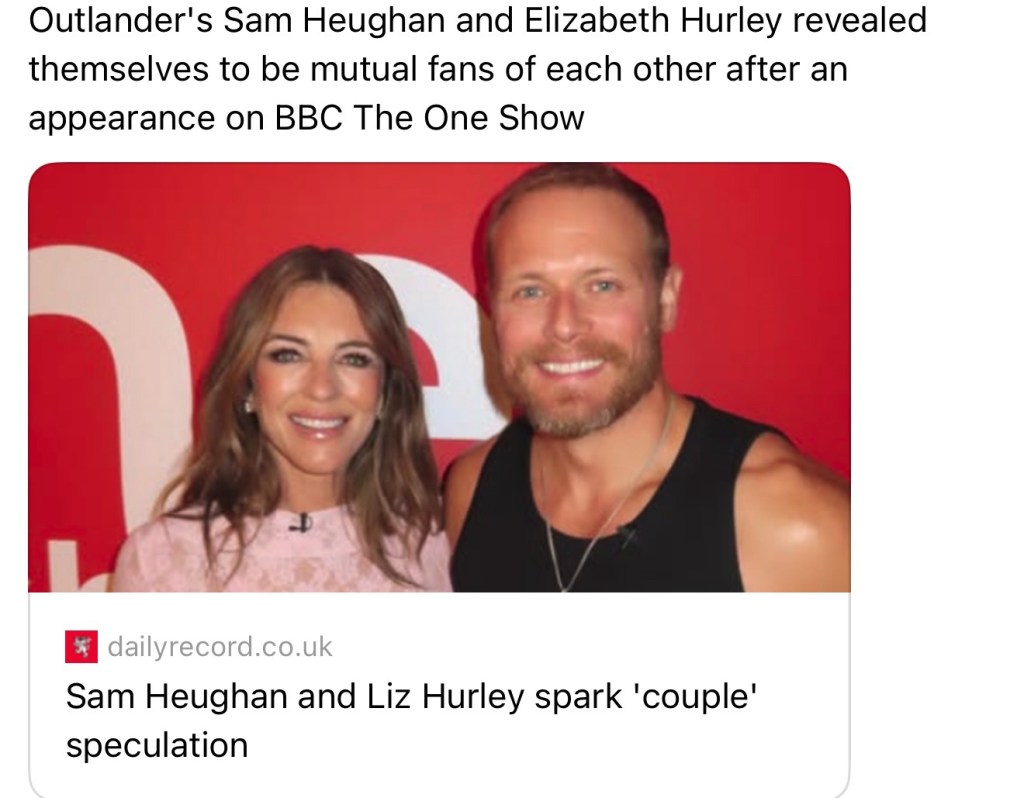
It was stated in the show that Liz has a boyfriend currently.Her and Sam have always been mutual fans of each other according to the both of them.Fans by now should know Sam well enough he would never put his private life in the spotlight and two of course he will compliment her as he is a very kind hearted human being and it was a mutual compliment not a romantic one.
California’s sanctuary state policies, particularly the California Values Act (SB 54) of 2017, have deepened national divisions by restricting local law enforcement’s cooperation with federal immigration authorities. SB 54 prohibits local police from detaining individuals for immigration violations unless they have been convicted of specific serious crimes, such as violent felonies. While supporters claim this protects vulnerable communities, critics argue it undermines federal authority and the rule of law. Democrats, particularly liberals in California, champion these policies, framing them as moral imperatives. This stance fuels contention, disrespects legal processes, and erodes trust across the nation. Every state in the United States—from Texas to New York, Florida to Washington—must respect and uphold immigration laws and all federal laws to maintain national unity and ensure fairness. When states pick and choose which laws to enforce, they weaken the foundation of a cohesive society.
The media, often aligned with liberal narratives, exacerbates this divide by downplaying the consequences of illegal immigration and criticizing enforcement efforts. This selective reporting distorts public perception, casting legal accountability as cruelty and ignoring the strain on communities. Liberal leaders and complicit media outlets must be held accountable for fostering an environment where disrespect for the law is normalized, as their actions deepen polarization and undermine the rule of law nationwide.
Illegal immigration itself is a divisive issue. The United States offers legal pathways—visas, asylum applications, and refugee programs—designed to balance humanitarian needs with security and fairness. Bypassing these channels is dishonest and disrespectful to those who endure lengthy legal processes. It’s not about labeling people as “illegal”; it’s about recognizing that unlawful actions have consequences. In 2024, U.S. Customs and Border Protection reported approximately 2.6 million migrant encounters at the southern border, up from 2.5 million in 2023, overwhelming resources and straining border communities. This influx can enable human smuggling, and while not directly tied to widespread crime, high-profile incidents involving undocumented individuals fuel public frustration.
Individuals have a responsibility to respect a nation’s laws, just as they would expect respect for their own communities. Legal immigration strengthens societies; illegal entry sows division and resentment. All 50 states share the duty to uphold federal laws, including immigration policies, to prevent the chaos that arises when laws are selectively enforced. States like California, by prioritizing ideology over legal accountability, set a dangerous precedent that others must avoid.
Democrats, the media, and all states must acknowledge their role in perpetuating this crisis by failing to consistently uphold legal standards. California’s sanctuary policies, driven by liberal agendas, risk tearing the country apart. For the United States to heal, every state, from Alabama to Wyoming, must commit to enforcing federal laws, ensuring immigration is addressed humanely while maintaining national unity and respect for the rule of law.








 Deep Thinking