Before everything changed, before love and trauma reshaped her life, Claire was still Claire Randall.
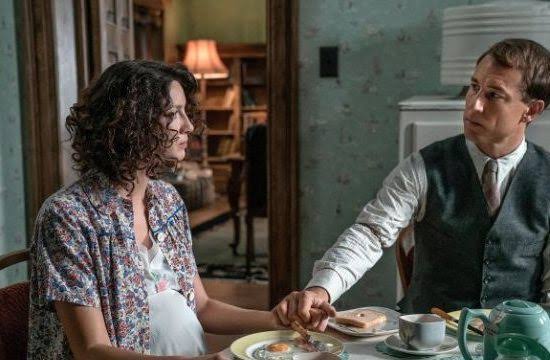
When the story begins, she’s on a second honeymoon with her husband after being separated by World War II. Their marriage didn’t feel broken to me. It didn’t feel strained in the way people later describe it. It felt like two people who had been pulled apart by circumstance and were trying — genuinely trying — to reconnect. There was structure. There was affection. There was a sense of order that made emotional sense to me.
As someone who is high-functioning autistic, I pay close attention to patterns, intentions, and cause-and-effect. At the beginning, the pattern is clear: Claire isn’t running from her marriage. She’s investing in it.
Her time travel isn’t a choice. It’s abrupt. Disorienting. Violent in its own way. One moment she’s anchored in something familiar, and the next she’s thrown into a world where survival replaces comfort. That kind of sudden disruption hits me hard as a viewer because I understand what it feels like when your sense of stability disappears without warning.
That distinction matters to me deeply.
Because everything that happens to Claire in the past happens while she is still Claire Randall. She doesn’t go looking for another life. She adapts because she has to. And adaptation is something I understand well. You don’t change because you want to — you change because staying the same would break you.
By the time she becomes Claire Fraser, the change has already happened.
One of the most disturbing parts of the story for me was Captain Black Jack Randall. Not just because of what he did, but because of how he looked. He wore Frank’s face. And as someone whose brain makes strong visual and emotional associations, I immediately understood why Claire could never separate the two cleanly again.
People often say, “But Frank didn’t do anything wrong.” And logically, that’s true. But trauma doesn’t work on logic. Once a face becomes associated with cruelty, control, and terror, your nervous system doesn’t ask for context. It reacts.
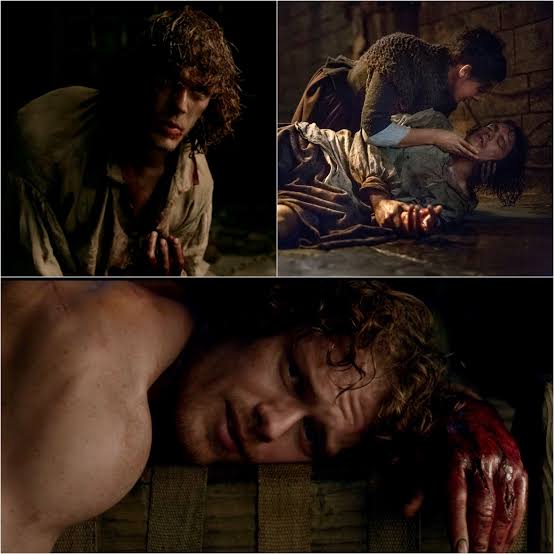
What Captain Black Jack Randall did to Jamie wasn’t just physical violence. It was methodical psychological destruction. Identity was stripped away. Autonomy was taken. And Claire didn’t just hear about it — she carried it. She held that knowledge inside her body, inside her memory, inside her sense of safety.
That kind of trauma doesn’t stay in the past. It changes how your brain categorizes the world.
Then Claire returns to her own time.
And she doesn’t return empty-handed.
She comes back pregnant — carrying Jamie’s child.
That detail matters to me more than it seems to for a lot of viewers. Because now Claire isn’t just processing trauma. She’s carrying a living, breathing connection to the man she loved, the life she lost, and the violence she witnessed. Jamie isn’t just a memory — he’s part of her future, growing inside her, even as she’s expected to resume a life that no longer fits.
As someone who experiences emotions deeply but processes them internally, I understand how overwhelming that would be. Claire isn’t just grieving. She’s holding grief, fear, love, and responsibility all at once — without a safe place to put any of it.
So when she comes back to Frank, I don’t see a woman being distant or unfair. I see a woman whose internal world has been fundamentally reorganized. She’s carrying another man’s child. She’s living with the knowledge of what was done to that child’s father — by a man who shares her husband’s face.
That is an impossible emotional equation.
This is where my perspective differs from many viewers.
I understand why people feel sorry for Frank. I can intellectually see his pain. But emotionally, my focus stays with Claire. Because I know what it’s like when your internal reality no longer matches what people expect from you on the outside.
Frank lost the version of Claire he remembered.
Claire lost her sense of safety, her innocence, the man she loved, and the life she built — all while preparing to become a mother under circumstances she never chose.
Those losses don’t weigh the same to me.
What stood out to me more as the story continued was how Frank struggled with Claire’s inability to return to who she was. From my perspective, his need for control and restoration felt less like love and more like discomfort with unpredictability — something I recognize, because unpredictability unsettles people who rely on emotional norms.
But Claire couldn’t perform normal anymore. She couldn’t mask what she’d been through.
She wasn’t being cold.
She wasn’t being ungrateful.
She was changed.
And expecting her to be otherwise would have meant denying everything she endured — including what was done to Jamie, and the child she carried back with her.
This part of the story stayed with me because it didn’t offer neat resolutions. It showed what happens when two people are separated not by lack of love, but by lived experience. One person went through something that rewired their entire internal world — and the other never could.
That feels painfully real to me.
And it changed the way I saw Frank — not as a monster, but as someone who could never fully cross the distance trauma created.
Some faces never look the same again.
Some loves don’t fail — they’re transformed beyond return.





 Deep Thinking