The recent passing of James Van Der Beek has brought out an overwhelming wave of love, support, and remembrance. And it should. A family has lost a husband. Children have lost their father. Friends have lost someone they shared life with. That is not a headline. That is heartbreak.
What has been harder to understand is the backlash — the criticism of people offering support, the cynical comments, the tone of “why are people making such a big deal about it?” as if grief has to pass some kind of approval process before it’s allowed.
I am extremely ashamed at how so many people seem not only out of touch with one another, but out of touch with basic humanity. Somewhere along the way, empathy became optional. Compassion became suspicious. And kindness became something people feel entitled to mock.
And yes — I am addressing the nasty remarks on Threads.
The sarcasm. The dismissiveness. The eye-rolling takes. The “why does this even matter?” crowd.
It matters because a family is grieving.
It matters because cancer is brutal.
It matters because whether you followed his career or not, a human being lost his life and children lost their father.
What I’ve seen online is disappointing at best and disturbing at worst. People hiding behind profile pictures, reducing someone’s death to a talking point or a punchline. That kind of detachment isn’t strength. It isn’t intelligence. It’s disconnection.
And if I’m being honest, I think some of the hostility toward celebrities often comes from something deeper — resentment. There are people who look at someone who pursued a creative career, worked relentlessly at their craft, faced rejection, uncertainty, and public scrutiny, and still built something meaningful… and instead of respecting that, they belittle it.
Maybe because it’s easier to mock someone’s success than to pursue your own growth. Maybe because it’s uncomfortable to see someone dedicate their life to something and earn respect for it. Hard work in the arts is still hard work. Dedication to a craft still deserves dignity and honor.
And by the way — money is not everything. It is a tool for survival. It can provide comfort and opportunity, yes. But it does not make someone less human. It does not make loss hurt less. And it certainly does not justify hatred. Don’t hate people who have more. Don’t look down on those who have less. Wealth does not measure worth. Character does.
Here’s the reality: acting is a career.
It’s not “just being famous.” It’s not “just being on TV.” It’s long hours, constant rejection, auditions, travel, sacrifice, and years of uncertainty. It’s building a life in an industry where most people don’t make it. When someone spends decades building that career, they are not simply a character on a screen. They are a human being who worked for their place in the world.
People form connections through stories. Through performances that carried them through breakups, illness, loneliness, growing up. Art matters. Storytelling matters. And the people who create it matter.
You don’t have to be a fan to be respectful.
You don’t have to admire someone’s work to honor their humanity.
You don’t have to understand someone’s career to recognize that their family is grieving.
Criticizing compassion says more about the critic than the moment.
We can disagree on politics.
We can disagree on entertainment.
We can disagree on opinions.
But grief should never be a battleground.
Celebrities are not fictional. They have spouses who cry behind closed doors. They have children who don’t care about fame — they just want their dad. They have families navigating hospital rooms, fear, and the unbearable quiet that follows loss.
Kindness costs nothing.
Compassion should never be controversial.
Respect should not require agreement.
And empathy should not come with conditions.
Sometimes the most radical thing we can do in a loud, angry world is simply choose decency.
To James Van Der Beek’s wife, children, extended family, and loved ones — my deepest and most heartfelt condolences. No public support can take away your pain, but I hope the love being shared reminds you that his work touched many lives. May you be surrounded by comfort, privacy, and strength in the days ahead. Your loss is seen, and it matters.
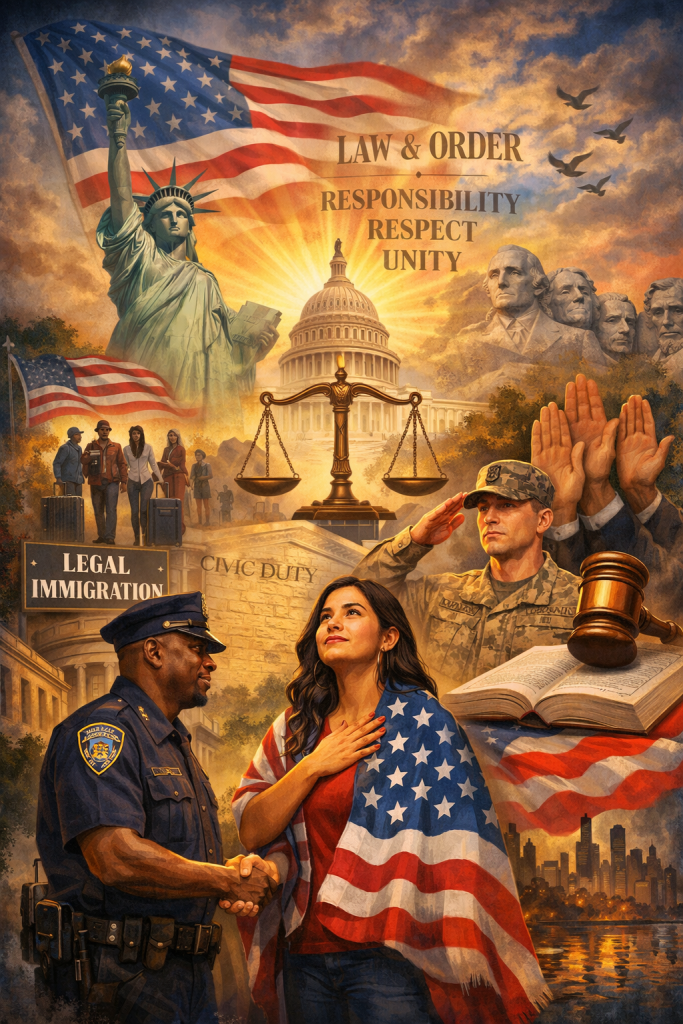
America’s story is often reduced to a single phrase: “Immigrants built this country.” Immigration absolutely played an important role — but it was never the only thing that held this nation together.
America was built on shared values: respect for law, personal responsibility, civic duty, and a commitment to something larger than ourselves. Immigration worked because it was paired with those principles — not because they were ignored. A nation is not just people crossing borders; it is a social contract.
People from many cultures and backgrounds came here seeking opportunity. What made that possible wasn’t the absence of rules — it was the presence of them. Historically, those who came understood that laws mattered, institutions mattered, contribution mattered, and respect for the country mattered. They didn’t just arrive — they participated.
Immigration alone does not build a nation. Shared responsibility does.
Law and order are often portrayed today as cold or uncaring, but in reality, they are what make fairness possible. Laws exist to create stability, protect communities, and ensure equal standards. Without immigration laws, legal immigrants are devalued, systems become inconsistent, trust erodes, and everyday citizens and lawful newcomers carry the burden.
A society without rules doesn’t become more humane — it becomes chaotic. And chaos harms the most vulnerable first. Respecting immigration law is not about rejecting people; it is about preserving a system that can function for everyone.
What is especially troubling today is the growing hostility toward law enforcement that is being amplified in cultural and public discourse. When influential voices frame police broadly as enemies rather than as individuals tasked with maintaining order, it fuels division rather than solutions.
Law enforcement officers are not symbols — they are people. They are human beings doing difficult work to protect communities, enforce laws, and respond to crime. Criticism and reform are part of a healthy democracy, but vilification without nuance is not. When hostility toward law enforcement becomes normalized, it leads to increased tension, loss of trust, and real-world harm.
Supporting law enforcement does not mean ignoring accountability. It means rejecting blanket hatred and recognizing that order is necessary for freedom to exist.
There is also an important truth that must be said with clarity and humanity: being in a country comes with obligations. If someone is not a citizen, the expectation is not hostility — it is respect for the law. That includes proper documentation, lawful behavior, and respect for the people and institutions of the country.
This is not cruelty; it is consistency. People who come here legally, follow the process, and live peacefully deserve dignity and protection. But when individuals commit crimes or show open hostility toward the country and its people, it is reasonable for society to expect accountability. No nation can survive if it excuses criminal intent or contempt for its laws in the name of compassion.
Another value we are losing is basic respect for leadership, regardless of political opinion. You do not have to agree with the president to show respect. Disagreement is not an excuse for dehumanization. Compassion, decency, and civility should not disappear because of politics.
Respecting the office matters because it reflects respect for the nation itself. We can challenge policies, question decisions, and advocate for change without tearing down the dignity of leadership or encouraging hostility toward the institutions that hold the country together.
America did not thrive because it welcomed everyone without standards. It thrived because it welcomed people into a framework of shared expectations. That balance — openness with responsibility, compassion with law, diversity with unity — is what allowed people from different backgrounds to build something lasting together.
Protecting that balance is not hateful, cruel, or backward. It is an act of respect — for the United States, for its people, and for the idea that freedom works best when it is paired with responsibility.
At its core, this is not about politics. It is about human decency, mutual respect, and remembering that a nation survives not only on who enters it — but on what its people agree to uphold once they are here.
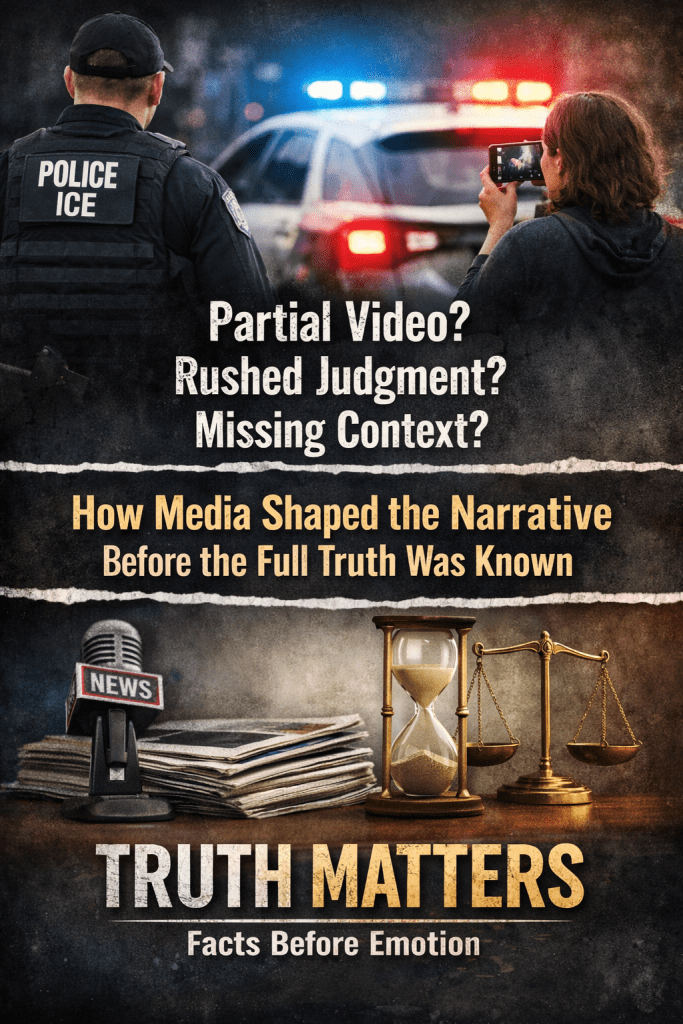
In the aftermath of the Minneapolis incident involving ICE officers, public opinion did not develop slowly or with full information. It formed quickly — largely based on how the event was first presented rather than on a complete understanding of what actually happened.
Before most people ever saw the full timeline, a narrative had already taken hold. That narrative was built around selective video clips, emotionally charged commentary, and the absence of early context. The first footage widely circulated was not the beginning of the encounter, but a later moment framed in a way that implied the officer was at fault.
Once that implication was established, everything that followed was interpreted through it.
The Order of the Clips Was Not Neutral
The first clip shown to the public began close to the moment force was used. In many cases, it was shared without clearly stating that it was partial footage rather than the full interaction.
Viewers were not initially told that:
The clip did not show how the encounter began
Earlier footage existed
Verbal commands had already been issued
The situation was still unfolding rapidly
When people are shown a dramatic moment without its lead-up, they naturally fill in the gaps. Headlines, captions, and commentary often guide those assumptions.
First impressions matter. In this case, that first impression was built on incomplete information.
What Later-Released Footage Shows
Later footage provided a broader view of the encounter.
Based on available video and official statements, two officers were present and working together.
One officer issued clear verbal commands instructing the woman to exit her vehicle. She did not comply with those instructions.
A second officer was assisting the first and positioned nearby.
At some point during this interaction, the vehicle moved backward and then forward, and contact was made with the assisting officer. Following this sequence, a weapon was discharged.
This does not answer every question, nor does it diminish the seriousness of the outcome. However, it does establish that the encounter involved noncompliance, vehicle movement, and risk to an officer — rather than a single isolated action.
That distinction matters when evaluating decisions made in seconds.
How Leaving Out the Beginning Changes Perception
When coverage begins at the moment force is used, responsibility appears to shift automatically.
Without the earlier footage:
The officer’s actions appear sudden
The refusal to comply is not visible
The danger to the assisting officer is unclear
The event appears static rather than rapidly evolving
Chronology is replaced with assumption.
By the time fuller footage becomes available, many people have already reached conclusions. At that point, added context can feel inconvenient rather than informative — even when it is essential.
Why Was the Woman There in the First Place?
Another question that received limited attention early on is why the woman was present during an active federal enforcement operation.
ICE operations do not occur randomly. Officers do not approach individuals or vehicles without a lawful reason tied to an ongoing action. While not all details have been publicly released, this encounter did not begin in a vacuum.
Some officials have suggested the woman may have been present in a way that interfered with the agents’ work. Others have disputed aspects of that claim. What has not been conclusively established is her intent.
That distinction matters. Responsible analysis requires separating what is confirmed, what is alleged, and what remains unknown. Assuming intent — either malicious or benign — without verified evidence contributes to misinformation.
If She Was Just Going About Her Business, Why Did She Refuse to Comply?
This is a reasonable question and one that deserves careful consideration.
If someone is simply going about their day, refusing to comply with clear verbal instructions during an enforcement action naturally raises concern. From an officer’s perspective, refusal to comply can signal uncertainty, risk, or potential interference — particularly when combined with vehicle movement.
At the same time, refusal alone does not establish intent. People may refuse instructions for many reasons, including confusion, fear, misunderstanding, or mistrust. What matters is acknowledging that refusal occurred while also recognizing that the motivation behind it has not been fully established.
Ignoring the refusal entirely removes a key element of the timeline and oversimplifies how risk is assessed in real time.
Why Didn’t the Officer Just Jump Out of the Way?
Another common question is why the officer did not simply jump out of the way.
This question assumes time, space, and predictability that often do not exist in fast-moving encounters. Vehicles can accelerate suddenly, change direction, and close distance in fractions of a second. Officers positioned near a vehicle may have limited room to move, obstacles nearby, or other people in the area that restrict escape.
Human reaction time under stress is extremely limited. Officers must process commands, positioning, surroundings, and the presence of others simultaneously. There may be no opportunity to calculate and execute an evasive move before impact.
This does not mean the question is invalid. It means it should be considered within the realities of real-world reaction time rather than hindsight.
How Media Framing Slips Into Propaganda
Modern propaganda does not usually rely on outright falsehoods. It relies on sequencing, omission, and emotional emphasis.
The most inflammatory moment is shown first.
Context is delayed or minimized.
Viewers are encouraged to react before understanding.
This does not require coordination or conspiracy. It thrives in fast-paced media environments driven by speed, outrage, and engagement.
Division Is the Outcome — and Often the Incentive
Outrage spreads faster than nuance. Conflict travels farther than chronology.
When stories are framed around blame rather than process, audiences are pushed into rigid camps. Nuance slows momentum. Full timelines complicate outrage. As a result, they are often sidelined.
Instead of encouraging understanding, coverage fuels rhetoric — and rhetoric fuels division.
I Don’t Take Sides — I Care About Truth
This matters to say clearly: I don’t take sides.
I’m not interested in defending institutions, attacking individuals, or aligning with political tribes. I care about what is factual, what is verified, and what is still unknown.
That means asking uncomfortable questions:
Why do people accept media framing without verification?
Why does emotionally driven coverage travel farther than careful reporting?
Why is bias acknowledged but rarely challenged in practice?
These are questions of media literacy, not politics.
A Personal Pause on Propaganda
A few years ago, I found myself getting caught up in the propaganda machine as well. I didn’t recognize it at first. Like many people, I was reacting to headlines and clips without slowing down to question what I was seeing — or what I wasn’t.
I had to pause and remember something my dad always said: propaganda is the enemy of the people.
Not because it always lies outright, but because it stirs emotion before understanding. It provokes reaction instead of thought. And in the end, it doesn’t benefit anyone. It causes harm.
That reminder changed how I consume information. I slow down. I research. I look for full timelines. I try to separate verified facts from assumptions and emotionally driven narratives.
Why Accuracy Is Essential for Accountability
Accountability cannot exist without accuracy.
When blame is assigned before facts are established:
Public debate becomes ideological
Trust in journalism erodes
Institutions lose credibility
Communities fracture
Most importantly, people lose the ability to distinguish between what happened and how it was framed.
Context Is Not a Defense — It Is a Requirement
A life was lost. That deserves careful and honest scrutiny.
But scrutiny that begins with implication instead of information is not justice — it is distortion.
You cannot fairly evaluate decisions made in seconds if you are only shown one moment. And you cannot understand risk if you are never given the full sequence of events.
Final Thought
Questioning authority matters.
Demanding transparency matters.
But neither can exist without:
Full timelines
Verified information
Honest framing
Critical thinking
Truth does not need propaganda.
It needs patience and integrity.
Editor’s Note
This piece reflects information available at the time of writing. Some details remain under investigation, and additional facts may emerge. The goal here is not to assign guilt or defend any party, but to examine how media framing, partial footage, and emotional narratives can shape public perception before the full context is understood.
In a time when blocking, canceling, and arguing have replaced understanding, kindness is becoming rare. This post explores what it truly means to be kind, why society struggles to stay compassionate, and how Sam Heughan’s words remind us that empathy, respect, and presence still matter.
The Lost Art of Kindness: Why Respect Still Matters (and What Sam Heughan Teaches Us About Compassion)
Kindness — real, genuine kindness — isn’t about being “nice” or saying what others want to hear.
It’s about empathy in motion: seeing someone’s need, understanding their feelings, and responding with care — not because it benefits you, but because it’s the right thing to do.
The Mental Health Foundation defines kindness as “choosing to do something that helps others or yourself, motivated by genuine warm feelings.”
It’s a choice — and one that’s becoming harder for many to make.
In today’s world, kindness often gets overshadowed by competition, ego, and the constant noise of social media. People are quicker to argue than to listen, to block rather than engage, and to cancel instead of converse. Yet, science consistently shows that kindness improves not just emotional health but also physical well-being — lowering stress, strengthening relationships, and even helping us live longer.
So if kindness benefits everyone… why is it fading?
Why Kindness Matters — and What Happens When We Lose It
Kindness is one of the oldest and most powerful tools for human connection.
When we show empathy, it builds trust. When we choose patience, it builds understanding.
But when kindness fades, division grows.
Research from Columbia University shows that acts of kindness reduce cortisol levels (the stress hormone) and boost serotonin — the chemical that helps us feel calm and happy. On the flip side, chronic anger and negativity literally rewire the brain toward fear and defensiveness.
Without kindness, relationships become fragile, communication turns hostile, and compassion gives way to self-interest.
We stop seeing people as people — and start seeing them as opponents.
That’s the quiet cost of losing kindness: we trade connection for control.
When Did We Forget How to Be Kind?
Maybe the problem isn’t that we don’t want to be kind — it’s that we’ve mistaken kindness for agreement.
Somewhere along the line, society began to confuse disagreeing with being disrespectful.
If someone challenges our beliefs, the instant reaction is often to cut them off — unfriend, unfollow, block.
But here’s the question:
👉 When you choose to debate someone respectfully, and you both stay civil — why block that person?
Because they don’t agree with you? That’s not right.
True kindness isn’t about protecting your comfort zone.
It’s about respecting others even when your views don’t align.
It’s saying, “I hear you, even if I see things differently.”
Healthy debate — the kind rooted in mutual respect — is one of the highest forms of kindness. It says: You matter enough for me to listen.
Blocking or silencing someone just because they disagree doesn’t show strength — it shows fear.
And when we start shutting each other down instead of talking through differences, we lose not only understanding but the very thing that makes kindness meaningful: connection.
What Sam Heughan Reminds Us About Compassion and Presence
Sam Heughan may be best known for Outlander, but his attitude off-screen speaks volumes about the kind of compassion our world needs more of.
He’s talked openly about the importance of being genuine, listening to others, and staying grounded — values that mirror the essence of true kindness.
He once said:
“There’s something about the silence of people listening to someone or watching someone — I just… I love that.”
That simple thought captures the heart of empathy: presence.
Being fully present with someone — giving your attention instead of your opinion — is one of the most generous things you can do.
Heughan has also said,
“If there’s one thing we can use more of in this world, it’s compassion and kindness.”
And he’s right. Compassion and kindness aren’t just emotional ideals — they’re necessary tools for healing the social divides we live with every day.
Heughan’s example reminds us that you can be strong and successful while still being gentle and respectful.
Kindness doesn’t make you weak; it makes you wise.
How to Bring Kindness Back — Starting With Ourselves
Kindness doesn’t begin with grand gestures. It starts in small, quiet moments — and in the courage to stay kind even when it’s hard.
Here are a few ways to reclaim kindness in your daily life:
Be present. Put your phone down and listen — really listen — to the person in front of you.
Respectfully disagree. Debate without hate. Challenge ideas, not people.
See the unseen. Notice the coworker who’s struggling, the neighbor who seems alone, the friend who goes quiet.
Be kind to yourself. You can’t pour from an empty cup. Rest is not weakness; it’s fuel.
Lead by example. The most powerful way to inspire kindness is to live it — especially when others don’t.
Pause before reacting. A calm response can turn conflict into understanding.
Remember presence is power. Just showing up for someone can change their entire day.
As research shows, kindness is contagious. One act inspires another, creating a ripple effect that can reach farther than we ever see.
Conclusion: Choosing Kindness in a Divided World
Kindness is not about agreement; it’s about respect.
It’s not about being “nice” to everyone; it’s about seeing people as human — even when you disagree.
We live in a time when opinions clash louder than compassion speaks, but kindness gives us a way back.
It rebuilds bridges, softens hearts, and creates space for understanding.
Sam Heughan’s reminder couldn’t be more timely: the world needs more compassion and kindness.
And that starts with each of us — choosing empathy over ego, patience over pride, and respect over rejection.
You don’t have to fix the whole world.
Just start with one moment — one word, one act, one choice to be kind — even when it’s hard.
In today’s political world, the line between honest criticism and a smear campaign is often hard to see. Both major U.S. political parties have used tactics meant to damage opponents, sometimes through exaggerated or misleading stories. In the digital age, a single post or video clip can spread faster than facts can catch up.
What a Smear Campaign Really Is
A smear campaign is a coordinated effort to damage someone’s reputation through partial truths, emotional framing, or outright falsehoods. These stories often mix real information with misleading context to make them sound believable. The goal isn’t just to criticize — it’s to make the public distrust or dislike the person being targeted.
How Misinformation Spreads
Social media has become the main arena for modern political battles. Algorithms reward outrage and sensationalism, so misleading posts often get more attention than factual ones. Studies show that false stories can travel several times faster online than verified reporting. Once they spread, corrections rarely reach as many people.
When the Target Is a President
Public figures, especially presidents, receive intense scrutiny. President Donald Trump has been one of the most frequent subjects of misinformation — both positive and negative — since entering politics. Some stories about him have later been proven false or exaggerated.
Examples:
White House ballroom project: Some posts claimed the president was “prioritizing a personal ballroom over governing” or that it was fully taxpayer-funded. In reality, reports clarified that donor funding was expected to cover much of the cost, and the project did not halt government operations. Headlines often cherry-picked quotes or images to make the project seem more scandalous than it was.
Food-aid programs (SNAP): Viral stories sometimes claimed the administration “cut all benefits” or “ended food assistance” for hundreds of thousands of people. The truth is more nuanced: certain policy adjustments and eligibility reviews did reduce some caseloads, but court rulings and program rules prevented wholesale eliminations. Simplified posts ignored those details, exaggerating the story for dramatic effect.
Legal and advocacy organizations, including the American Center for Law and Justice (ACLJ), have publicly defended President Trump, arguing that he has often been unfairly portrayed or targeted by misleading information. Others counter that this level of attention comes with the job and that every president faces scrutiny. The truth usually lies somewhere in between, and it highlights how important careful fact-checking and balanced reporting are when emotions run high.
Recognizing Bias
Bias doesn’t always mean lying — it can be about what facts are chosen, what tone is used, and which voices are amplified. Left-leaning and right-leaning media often frame the same story in completely different ways. Reading from multiple outlets, especially those that provide citations or link to source documents, helps reveal where interpretation ends and evidence begins.
A Free Thinker’s Perspective
As I’ve mentioned before, I don’t belong to either political party — and for good reasons. Both parties have lost sight of what truly matters: serving the people and strengthening the country. Too often, their behavior resembles children fighting rather than adults leading. I choose to keep a clear mind and remain a free thinker because I believe it’s important for everyone to step back and look at how we, as citizens, are behaving. If this is how we choose to represent the United States — through division, insults, and blind loyalty — then we all need to ask ourselves what kind of example we’re setting for the next generation.
I trust the sources of the American Center for Law and Justice because I believe they offer more accurate insight and have a deeper understanding of what’s happening in our government than many mainstream news outlets. I want to encourage people to take a step back, get out of the constant media noise, and clear their heads. Too often, the headlines are designed to stir anger and division — it’s up to each of us to think independently and not get caught up in the heat.
What Readers Can Do
Check sources. If a story doesn’t cite where the information came from, be cautious.
Look for primary documents. Press releases, court filings, or government data are better than opinion pieces.
Avoid reaction-sharing. Wait a few hours before reposting — many “breaking” stories change as facts come out.
Use fact-checkers. Sites like AP Fact Check, Reuters, and FactCheck.org review viral claims from all sides.
Final Thoughts
Misinformation isn’t new, but the speed and reach of social media have made it more powerful than ever. Whether it targets Donald Trump, Joe Biden, or any other public figure, the pattern is the same: partial truths, emotional framing, and mass sharing. The best defense isn’t cynicism — it’s curiosity, critical thinking, and checking before believing.
This flower stands as a symbol of America today. Its petals, darkened and heavy with drops of water, reflect the struggles our nation carries—the weight of division, the storms of uncertainty, and the trials that test our strength.
But like this flower, America does not fall. Even in the darkest hour, its foundation is strong, its roots unshaken. Our country has faced hardship before—wars, depressions, and deep divides—and each time, we have risen stronger, united by the belief that freedom and justice are worth fighting for.
The battle we face today is not just about politics or power. It is about remembering who we are as a people. It is about choosing unity over division, strength over fear, and faith in the promise of tomorrow.
Just as the flower carries the storm and still stands tall, so will America. Because this nation was built to endure, built to overcome, and built to shine again.
Exploring the biblical roots of the Israel-Palestine conflict, this post highlights Jerusalem’s significance, the story of Jacob and Esau, Israel’s defense, Hamas aggression, and the role of international recognition in escalating tensions.
The Biblical Roots of Israel and Palestine’s Feud
Introduction: History Guides the Present
The Israel-Palestine conflict is often seen as modern politics, but its roots go back to biblical times. The story of Jacob and Esau, two brothers whose rivalry shaped nations, mirrors the tensions between Israel and Palestine.
The Bible, as the Word of God, documents history from past to present and even hints at future events. Its accounts of Israel provide crucial context for understanding today’s disputes.
Jacob and Esau: A Story of Conflict and Reconciliation
Jacob and Esau were twin brothers, sons of Isaac and Rebekah. Even before birth, they struggled in the womb (Genesis 25:22), foreshadowing lifelong rivalry.
Esau, the elder, was strong and favored by his father. Jacob, clever and chosen by his mother, obtained Esau’s birthright and blessing (Genesis 25–27). Esau’s anger forced Jacob to flee. Years later, Jacob returned carefully and reconciled with Esau (Genesis 33).
This story highlights conflict, rivalry, and resolution through humility and foresight—a principle still relevant today.
Biblical Parallels to Israel and Palestine
Israel: Descendants of Jacob, promised the land of Canaan, with Jerusalem as their eternal capital. Israel has historically sought peace and never attacks first, acting defensively to protect its people. Palestine: Groups opposing Israel, historically and today, often instigate conflict. Recent attacks on Israel are linked to Hamas, an armed group that perpetuates violence and escalates tensions.
Just as Jacob and Esau’s rivalry caused long-term tension, disputes over land and recognition have fueled centuries of conflict between Israel and Palestine.
Jerusalem: Israel’s Eternal Capital
Jerusalem is Israel’s spiritual and political heart, granted to the descendants of Jacob. Attempts to claim it for others or recognize Palestinian sovereignty over it ignore biblical and historical truths.
Modern Political Implications
Unilateral Recognition of Palestine: Countries like Canada, Australia, and the UK risk marginalizing Israel and empowering Hamas. Diplomatic Isolation: Israel could be excluded from critical negotiations despite its commitment to peace. Escalating Tensions: Rewarding unilateral claims encourages aggression rather than dialogue, echoing unresolved rivalry between Jacob and Esau.
Toward Peace
Peace requires recognizing rightful inheritance and acting wisely:
Respect Israel’s biblical and historical claims. Understand Israel acts in self-defense, not as an aggressor. Address Hamas’s role in perpetuating conflict. Encourage dialogue and compromise, not unilateral recognition. Support Palestinian development and aid without undermining Israel’s security.
A Call to Action
I encourage readers to peacefully call out Canada, Australia, and the UK for recognizing Palestine without negotiation, using reasoned arguments based on history and justice.
People also need to hold their governments accountable. Electing leaders who listen to citizens, act with foresight, and prioritize common sense can ensure foreign policy aligns with reason, stability, and moral responsibility. Peaceful advocacy is the path to change.
Conclusion
The Israel-Palestine feud is deeply biblical and historical. Jerusalem and the land of Israel belong to the Jewish people, as established by God. The Bible records events from the past, guides us in the present, and points to lessons for the future.
Recognizing Palestine without negotiation deepens Israel’s isolation, rewards aggression by groups like Hamas, and perpetuates conflict. Understanding history and advocating peacefully supports true peace while honoring Israel’s rightful inheritance.




 Deep Thinking