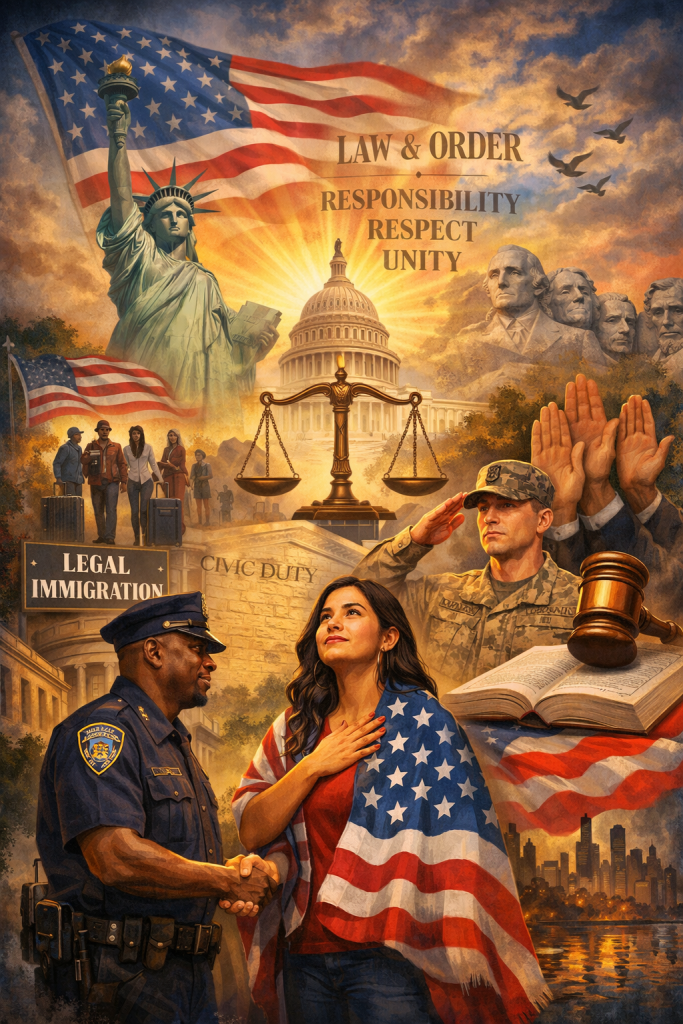
America’s story is often reduced to a single phrase: “Immigrants built this country.” Immigration absolutely played an important role — but it was never the only thing that held this nation together.
America was built on shared values: respect for law, personal responsibility, civic duty, and a commitment to something larger than ourselves. Immigration worked because it was paired with those principles — not because they were ignored. A nation is not just people crossing borders; it is a social contract.
People from many cultures and backgrounds came here seeking opportunity. What made that possible wasn’t the absence of rules — it was the presence of them. Historically, those who came understood that laws mattered, institutions mattered, contribution mattered, and respect for the country mattered. They didn’t just arrive — they participated.
Immigration alone does not build a nation. Shared responsibility does.
Law and order are often portrayed today as cold or uncaring, but in reality, they are what make fairness possible. Laws exist to create stability, protect communities, and ensure equal standards. Without immigration laws, legal immigrants are devalued, systems become inconsistent, trust erodes, and everyday citizens and lawful newcomers carry the burden.
A society without rules doesn’t become more humane — it becomes chaotic. And chaos harms the most vulnerable first. Respecting immigration law is not about rejecting people; it is about preserving a system that can function for everyone.
What is especially troubling today is the growing hostility toward law enforcement that is being amplified in cultural and public discourse. When influential voices frame police broadly as enemies rather than as individuals tasked with maintaining order, it fuels division rather than solutions.
Law enforcement officers are not symbols — they are people. They are human beings doing difficult work to protect communities, enforce laws, and respond to crime. Criticism and reform are part of a healthy democracy, but vilification without nuance is not. When hostility toward law enforcement becomes normalized, it leads to increased tension, loss of trust, and real-world harm.
Supporting law enforcement does not mean ignoring accountability. It means rejecting blanket hatred and recognizing that order is necessary for freedom to exist.
There is also an important truth that must be said with clarity and humanity: being in a country comes with obligations. If someone is not a citizen, the expectation is not hostility — it is respect for the law. That includes proper documentation, lawful behavior, and respect for the people and institutions of the country.
This is not cruelty; it is consistency. People who come here legally, follow the process, and live peacefully deserve dignity and protection. But when individuals commit crimes or show open hostility toward the country and its people, it is reasonable for society to expect accountability. No nation can survive if it excuses criminal intent or contempt for its laws in the name of compassion.
Another value we are losing is basic respect for leadership, regardless of political opinion. You do not have to agree with the president to show respect. Disagreement is not an excuse for dehumanization. Compassion, decency, and civility should not disappear because of politics.
Respecting the office matters because it reflects respect for the nation itself. We can challenge policies, question decisions, and advocate for change without tearing down the dignity of leadership or encouraging hostility toward the institutions that hold the country together.
America did not thrive because it welcomed everyone without standards. It thrived because it welcomed people into a framework of shared expectations. That balance — openness with responsibility, compassion with law, diversity with unity — is what allowed people from different backgrounds to build something lasting together.
Protecting that balance is not hateful, cruel, or backward. It is an act of respect — for the United States, for its people, and for the idea that freedom works best when it is paired with responsibility.
At its core, this is not about politics. It is about human decency, mutual respect, and remembering that a nation survives not only on who enters it — but on what its people agree to uphold once they are here.
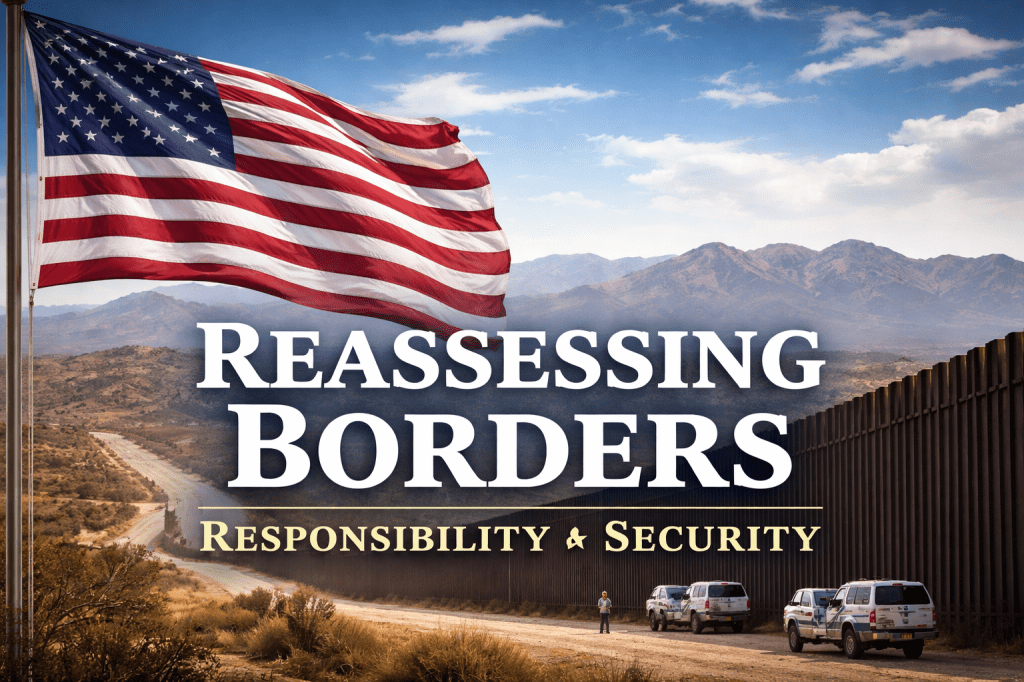
Few topics in modern discourse are as emotionally charged as borders. For many, opinions are formed quickly and defended fiercely, often without space for reflection. But meaningful conversations do not begin with certainty — they begin with courage. The courage to pause, question assumptions, and reassess what we believe we already understand.
This is not a call to abandon compassion. It is a call to think more deeply about how compassion actually works in the real world.
Why Reassessment Matters
Reassessment is uncomfortable because it requires humility. It asks us to consider that we may have inherited opinions rather than formed them ourselves. It challenges narratives we’ve repeated without fully examining their consequences.
Borders are often discussed in absolutes — either as symbols of cruelty or symbols of protection. Reality is more complex. Borders are not moral statements; they are functional necessities. They exist so laws can be applied fairly, systems can be managed responsibly, and a nation can meet its obligations to both its citizens and those who seek to enter.
Reassessing borders means shifting from emotional reactions to practical outcomes.
Separating Emotion From Function
Emotion is a natural human response, especially when discussions involve suffering and injustice. But emotion alone cannot build sustainable systems.
Borders function as organizing tools. They define where laws apply, how resources are allocated, and who is accountable. Without these boundaries, governance becomes arbitrary, enforcement becomes selective, and trust erodes.
Encouraging reassessment requires acknowledging a hard truth: good intentions do not guarantee good outcomes. In fact, policies driven purely by emotion often create the very harm they seek to prevent.
Order Is What Makes Compassion Possible
A common belief is that enforcement and empathy cannot coexist. This assumption deserves careful reconsideration.
Compassion without order leads to chaos.
Order without compassion leads to rigidity.
A functioning society requires both.
When borders are managed lawfully:
Asylum claims can be evaluated fairly
Aid can be directed where it is truly needed
Exploitation by criminal networks is reduced
Communities remain stable and safe
When systems are overwhelmed, compassion becomes inconsistent and selective. The most vulnerable suffer first. Reassessing borders means recognizing that structure is not the enemy of empathy — it is what allows empathy to endure.
Who Really Pays the Price for Ignored Borders?
It is worth asking who benefits when borders are disregarded.
Not migrants, who are often misled into dangerous journeys.
Not families, who face exploitation and abuse.
Not communities, who absorb the strain on schools, healthcare, and emergency services.
Not legal immigrants, who follow the rules only to see them dismissed.
Disorder benefits those who profit from chaos — traffickers, smugglers, and criminal networks.
Reassessment means evaluating results, not intentions.
The Rule of Law Deserves Reflection, Not Dismissal
Laws exist to create fairness and predictability. When laws are selectively enforced or ignored because enforcement is unpopular, they lose legitimacy.
A society cannot function on exceptions alone.
Encouraging people to reassess borders means asking difficult questions:
Should laws apply only when convenient?
Can justice exist without consistency?
What happens when enforcement disappears but expectations remain?
Borders are one of the primary ways a nation maintains the rule of law. Questioning how they are enforced is valid. Dismissing enforcement entirely is not.
Capacity Is Reality, Not Cruelty
Every system has limits. Healthcare, housing, education, infrastructure, and social services are finite. Ignoring those limits does not make a nation kinder — it makes it unstable.
Acknowledging capacity is not a moral failure. It is an act of responsibility.
Encouraging reassessment means reframing the conversation away from guilt and toward sustainability. A system that collapses under strain helps no one.
Reassessing Without Shame
Changing or refining an opinion is often treated as weakness. In reality, it is one of the strongest things a person can do.
Reassessment does not require abandoning values. It requires aligning them with reality.
You can care deeply about human dignity and still believe in enforcement.
You can support immigration and still expect laws to matter.
You can be empathetic and realistic at the same time.
Encouraging people to reassess borders means freeing them from false choices that demand moral purity at the expense of functionality.
The Courage to Think Independently
One of the healthiest acts in a divided culture is independent thinking. Not reaction. Not repetition. Thought.
Reassessment begins when we ask:
Have I examined outcomes, not just intentions?
Have I confused compassion with the absence of boundaries?
Have I allowed slogans to replace understanding?
Borders are not a test of who is good or bad. They are a test of whether a society is willing to govern itself responsibly.
Conclusion: Reassessment Is Not Betrayal — It Is Maturity
Borders are not about fear.
They are about responsibility.
They are about sustainability.
They are about protecting people from chaos — on every side.
Encouraging reassessment is not about winning an argument. It is about restoring thoughtful discourse in a world that often rewards outrage over understanding.
You do not have to agree to think critically.
You only have to be willing to reconsider.
That willingness — to pause, reflect, and reassess — is where progress actually begins.
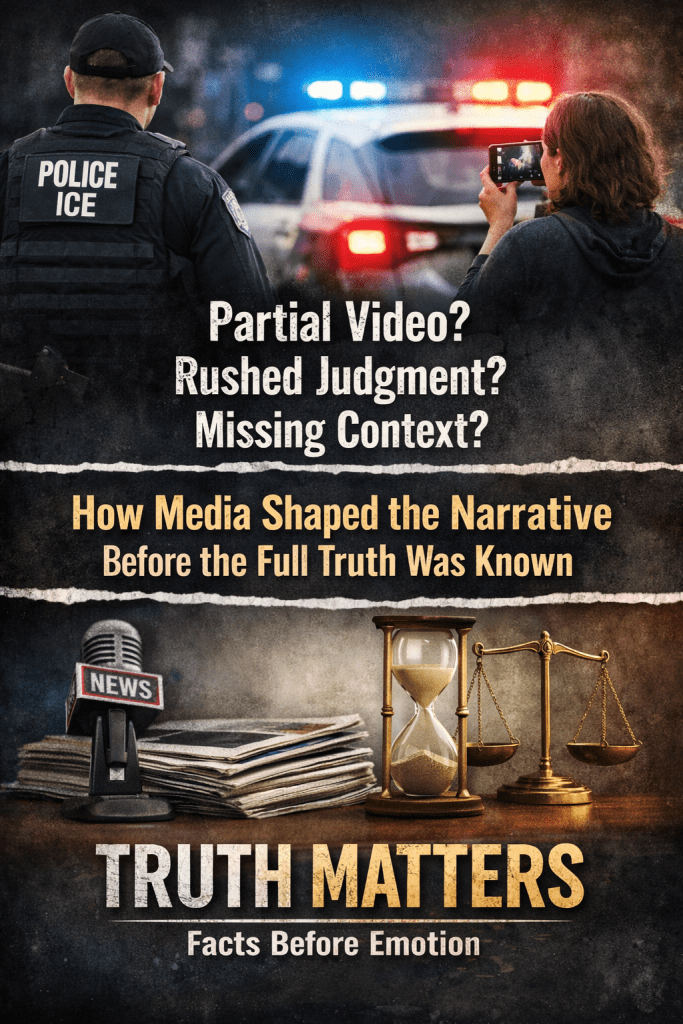
In the aftermath of the Minneapolis incident involving ICE officers, public opinion did not develop slowly or with full information. It formed quickly — largely based on how the event was first presented rather than on a complete understanding of what actually happened.
Before most people ever saw the full timeline, a narrative had already taken hold. That narrative was built around selective video clips, emotionally charged commentary, and the absence of early context. The first footage widely circulated was not the beginning of the encounter, but a later moment framed in a way that implied the officer was at fault.
Once that implication was established, everything that followed was interpreted through it.
The Order of the Clips Was Not Neutral
The first clip shown to the public began close to the moment force was used. In many cases, it was shared without clearly stating that it was partial footage rather than the full interaction.
Viewers were not initially told that:
The clip did not show how the encounter began
Earlier footage existed
Verbal commands had already been issued
The situation was still unfolding rapidly
When people are shown a dramatic moment without its lead-up, they naturally fill in the gaps. Headlines, captions, and commentary often guide those assumptions.
First impressions matter. In this case, that first impression was built on incomplete information.
What Later-Released Footage Shows
Later footage provided a broader view of the encounter.
Based on available video and official statements, two officers were present and working together.
One officer issued clear verbal commands instructing the woman to exit her vehicle. She did not comply with those instructions.
A second officer was assisting the first and positioned nearby.
At some point during this interaction, the vehicle moved backward and then forward, and contact was made with the assisting officer. Following this sequence, a weapon was discharged.
This does not answer every question, nor does it diminish the seriousness of the outcome. However, it does establish that the encounter involved noncompliance, vehicle movement, and risk to an officer — rather than a single isolated action.
That distinction matters when evaluating decisions made in seconds.
How Leaving Out the Beginning Changes Perception
When coverage begins at the moment force is used, responsibility appears to shift automatically.
Without the earlier footage:
The officer’s actions appear sudden
The refusal to comply is not visible
The danger to the assisting officer is unclear
The event appears static rather than rapidly evolving
Chronology is replaced with assumption.
By the time fuller footage becomes available, many people have already reached conclusions. At that point, added context can feel inconvenient rather than informative — even when it is essential.
Why Was the Woman There in the First Place?
Another question that received limited attention early on is why the woman was present during an active federal enforcement operation.
ICE operations do not occur randomly. Officers do not approach individuals or vehicles without a lawful reason tied to an ongoing action. While not all details have been publicly released, this encounter did not begin in a vacuum.
Some officials have suggested the woman may have been present in a way that interfered with the agents’ work. Others have disputed aspects of that claim. What has not been conclusively established is her intent.
That distinction matters. Responsible analysis requires separating what is confirmed, what is alleged, and what remains unknown. Assuming intent — either malicious or benign — without verified evidence contributes to misinformation.
If She Was Just Going About Her Business, Why Did She Refuse to Comply?
This is a reasonable question and one that deserves careful consideration.
If someone is simply going about their day, refusing to comply with clear verbal instructions during an enforcement action naturally raises concern. From an officer’s perspective, refusal to comply can signal uncertainty, risk, or potential interference — particularly when combined with vehicle movement.
At the same time, refusal alone does not establish intent. People may refuse instructions for many reasons, including confusion, fear, misunderstanding, or mistrust. What matters is acknowledging that refusal occurred while also recognizing that the motivation behind it has not been fully established.
Ignoring the refusal entirely removes a key element of the timeline and oversimplifies how risk is assessed in real time.
Why Didn’t the Officer Just Jump Out of the Way?
Another common question is why the officer did not simply jump out of the way.
This question assumes time, space, and predictability that often do not exist in fast-moving encounters. Vehicles can accelerate suddenly, change direction, and close distance in fractions of a second. Officers positioned near a vehicle may have limited room to move, obstacles nearby, or other people in the area that restrict escape.
Human reaction time under stress is extremely limited. Officers must process commands, positioning, surroundings, and the presence of others simultaneously. There may be no opportunity to calculate and execute an evasive move before impact.
This does not mean the question is invalid. It means it should be considered within the realities of real-world reaction time rather than hindsight.
How Media Framing Slips Into Propaganda
Modern propaganda does not usually rely on outright falsehoods. It relies on sequencing, omission, and emotional emphasis.
The most inflammatory moment is shown first.
Context is delayed or minimized.
Viewers are encouraged to react before understanding.
This does not require coordination or conspiracy. It thrives in fast-paced media environments driven by speed, outrage, and engagement.
Division Is the Outcome — and Often the Incentive
Outrage spreads faster than nuance. Conflict travels farther than chronology.
When stories are framed around blame rather than process, audiences are pushed into rigid camps. Nuance slows momentum. Full timelines complicate outrage. As a result, they are often sidelined.
Instead of encouraging understanding, coverage fuels rhetoric — and rhetoric fuels division.
I Don’t Take Sides — I Care About Truth
This matters to say clearly: I don’t take sides.
I’m not interested in defending institutions, attacking individuals, or aligning with political tribes. I care about what is factual, what is verified, and what is still unknown.
That means asking uncomfortable questions:
Why do people accept media framing without verification?
Why does emotionally driven coverage travel farther than careful reporting?
Why is bias acknowledged but rarely challenged in practice?
These are questions of media literacy, not politics.
A Personal Pause on Propaganda
A few years ago, I found myself getting caught up in the propaganda machine as well. I didn’t recognize it at first. Like many people, I was reacting to headlines and clips without slowing down to question what I was seeing — or what I wasn’t.
I had to pause and remember something my dad always said: propaganda is the enemy of the people.
Not because it always lies outright, but because it stirs emotion before understanding. It provokes reaction instead of thought. And in the end, it doesn’t benefit anyone. It causes harm.
That reminder changed how I consume information. I slow down. I research. I look for full timelines. I try to separate verified facts from assumptions and emotionally driven narratives.
Why Accuracy Is Essential for Accountability
Accountability cannot exist without accuracy.
When blame is assigned before facts are established:
Public debate becomes ideological
Trust in journalism erodes
Institutions lose credibility
Communities fracture
Most importantly, people lose the ability to distinguish between what happened and how it was framed.
Context Is Not a Defense — It Is a Requirement
A life was lost. That deserves careful and honest scrutiny.
But scrutiny that begins with implication instead of information is not justice — it is distortion.
You cannot fairly evaluate decisions made in seconds if you are only shown one moment. And you cannot understand risk if you are never given the full sequence of events.
Final Thought
Questioning authority matters.
Demanding transparency matters.
But neither can exist without:
Full timelines
Verified information
Honest framing
Critical thinking
Truth does not need propaganda.
It needs patience and integrity.
Editor’s Note
This piece reflects information available at the time of writing. Some details remain under investigation, and additional facts may emerge. The goal here is not to assign guilt or defend any party, but to examine how media framing, partial footage, and emotional narratives can shape public perception before the full context is understood.
In today’s political world, the line between honest criticism and a smear campaign is often hard to see. Both major U.S. political parties have used tactics meant to damage opponents, sometimes through exaggerated or misleading stories. In the digital age, a single post or video clip can spread faster than facts can catch up.
What a Smear Campaign Really Is
A smear campaign is a coordinated effort to damage someone’s reputation through partial truths, emotional framing, or outright falsehoods. These stories often mix real information with misleading context to make them sound believable. The goal isn’t just to criticize — it’s to make the public distrust or dislike the person being targeted.
How Misinformation Spreads
Social media has become the main arena for modern political battles. Algorithms reward outrage and sensationalism, so misleading posts often get more attention than factual ones. Studies show that false stories can travel several times faster online than verified reporting. Once they spread, corrections rarely reach as many people.
When the Target Is a President
Public figures, especially presidents, receive intense scrutiny. President Donald Trump has been one of the most frequent subjects of misinformation — both positive and negative — since entering politics. Some stories about him have later been proven false or exaggerated.
Examples:
White House ballroom project: Some posts claimed the president was “prioritizing a personal ballroom over governing” or that it was fully taxpayer-funded. In reality, reports clarified that donor funding was expected to cover much of the cost, and the project did not halt government operations. Headlines often cherry-picked quotes or images to make the project seem more scandalous than it was.
Food-aid programs (SNAP): Viral stories sometimes claimed the administration “cut all benefits” or “ended food assistance” for hundreds of thousands of people. The truth is more nuanced: certain policy adjustments and eligibility reviews did reduce some caseloads, but court rulings and program rules prevented wholesale eliminations. Simplified posts ignored those details, exaggerating the story for dramatic effect.
Legal and advocacy organizations, including the American Center for Law and Justice (ACLJ), have publicly defended President Trump, arguing that he has often been unfairly portrayed or targeted by misleading information. Others counter that this level of attention comes with the job and that every president faces scrutiny. The truth usually lies somewhere in between, and it highlights how important careful fact-checking and balanced reporting are when emotions run high.
Recognizing Bias
Bias doesn’t always mean lying — it can be about what facts are chosen, what tone is used, and which voices are amplified. Left-leaning and right-leaning media often frame the same story in completely different ways. Reading from multiple outlets, especially those that provide citations or link to source documents, helps reveal where interpretation ends and evidence begins.
A Free Thinker’s Perspective
As I’ve mentioned before, I don’t belong to either political party — and for good reasons. Both parties have lost sight of what truly matters: serving the people and strengthening the country. Too often, their behavior resembles children fighting rather than adults leading. I choose to keep a clear mind and remain a free thinker because I believe it’s important for everyone to step back and look at how we, as citizens, are behaving. If this is how we choose to represent the United States — through division, insults, and blind loyalty — then we all need to ask ourselves what kind of example we’re setting for the next generation.
I trust the sources of the American Center for Law and Justice because I believe they offer more accurate insight and have a deeper understanding of what’s happening in our government than many mainstream news outlets. I want to encourage people to take a step back, get out of the constant media noise, and clear their heads. Too often, the headlines are designed to stir anger and division — it’s up to each of us to think independently and not get caught up in the heat.
What Readers Can Do
Check sources. If a story doesn’t cite where the information came from, be cautious.
Look for primary documents. Press releases, court filings, or government data are better than opinion pieces.
Avoid reaction-sharing. Wait a few hours before reposting — many “breaking” stories change as facts come out.
Use fact-checkers. Sites like AP Fact Check, Reuters, and FactCheck.org review viral claims from all sides.
Final Thoughts
Misinformation isn’t new, but the speed and reach of social media have made it more powerful than ever. Whether it targets Donald Trump, Joe Biden, or any other public figure, the pattern is the same: partial truths, emotional framing, and mass sharing. The best defense isn’t cynicism — it’s curiosity, critical thinking, and checking before believing.
In times of division, it’s easy to forget what leadership really means.
The words “No Kings” have echoed through protests and headlines, warning of tyranny and unchecked power.
But what if we’ve lost sight of what a king actually is — and what a true leader should be?
Because despite how loudly the world argues, President Trump isn’t a king, and that truth says more about our system — and ourselves — than any slogan can capture.
1. Real Leaders Serve, They Don’t Rule
A crown can dazzle, but it also isolates.
True power doesn’t come from command — it comes from conscience.
A president is not chosen by blood or birthright. He’s chosen by people who believe in the idea that no man stands above the law.
That, in itself, is proof our nation still breathes democracy.
Even when he’s criticized, sued, or challenged, President Trump operates under the same framework as every president before him: the Constitution. That’s not kingship — that’s accountability in motion.
2. The Constitution Still Speaks — Even Through the Noise
It’s harder these days to hear its voice.
The endless shouting between parties, the slanted headlines, and the daily storm of propaganda blur the lines of what’s real and what’s not.
But the truth remains: the courts still rule, Congress still debates, and the people still vote.
If the system were broken, none of those things would still be happening.
We just have to stop, listen to our own intelligence, and see that much of the fear comes not from the Constitution failing — but from how we’re told to see it fail.
3. Strength Doesn’t Equal Tyranny
Leadership requires strength — but strength isn’t the same as domination.
President Trump can be bold, stubborn, even abrasive, but those traits don’t make him a monarch.
They make him a man leading within the boundaries of law, tested at every turn by a government built to resist him when necessary.
If he truly were acting like a king, there would be no resistance, no lawsuits, no public dissent.
And yet, the very people who call him one still have the freedom to do so openly.
That’s not tyranny — that’s proof the republic endures.
4. When Propaganda Wears a Smile
We talk about fascism like it always wears a uniform, but sometimes it hides behind polite language and polished media panels.
It’s become hard to tell where the Constitution is supposed to hold the government in check — not because it’s weak, but because truth itself has been crowded out by noise.
Some of that comes from Democratic leadership and mainstream media narratives that shame or silence dissent.
It’s manipulation dressed as moral superiority.
That, not one man’s executive orders, is where control begins to creep in.
5. The Measure of a Nation Is in Its People
A country doesn’t lose freedom when a leader acts boldly.
It loses freedom when its citizens stop thinking for themselves.
We have to reclaim that independence — the same kind that once inspired revolutions, art, and truth-tellers who challenged the crowd.
When we pause long enough to think — to feel beyond propaganda — we remember who holds the real power: us.
6. What This Moment Teaches
President Trump isn’t flawless. No leader is.
But he’s also not a king. He’s a man navigating a system still capable of holding him accountable — a system worth protecting.
We can disagree with his choices while still recognizing that democracy, though messy and imperfect, is still working.
It doesn’t belong to one party or one man — it belongs to every person who refuses to give up thinking for themselves.
Final Reflection
True leadership doesn’t need a crown, only conviction.
And real strength — the kind that inspires trust and loyalty — comes from knowing when to act, when to listen, and when to stand by what’s right even when the crowd shouts otherwise.
History’s greatest leaders, both in politics and art, carried that kind of quiet courage — the kind that doesn’t seek control but truth.
For far too long, politics in America has been driven less by honest debate and more by rhetoric and extremism. Instead of focusing on real solutions, both major parties have learned that fear, exaggeration, and emotional appeals are the fastest ways to capture attention and rally their base. It’s a strategy that may win elections—but it’s tearing our country apart.
How Democrats Use Rhetoric to Sway the People
Democrats have often leaned on dramatic, emotional language to push their policies. From the Vietnam era to today’s climate and healthcare battles, their playbook has been consistent: frame every issue as a moral crisis, paint opponents as cold-hearted or bigoted, and push urgency so strong that compromise feels impossible. Words like “the planet is doomed” or “healthcare is a human right or nothing” stir passion, but they also deepen divides.
How Republicans Respond in Their Own Way
Republicans are not immune to the same tactics. While Democrats warn of social collapse without their policies, Republicans often sound alarms about threats to freedom, tradition, or the Constitution. They label opponents “radicals” or “socialists,” using fear of lost liberties to energize their voters. At times, their rhetoric becomes just as extreme, warning of cultural destruction or government overreach at every turn.
In short: both parties have discovered that fear works. But it also leaves everyday Americans caught in the middle, exhausted and frustrated by leaders who prefer slogans over solutions.
What America Can Do to Fix It
The good news? We don’t have to accept politics as usual. America can—and must—change the rules that reward division:
Reform elections with ranked-choice voting and open primaries so leaders must appeal to a broader base. End gerrymandering by handing redistricting over to independent commissions. Limit the power of money in politics through public financing and stronger transparency. Strengthen civic education and media literacy so people can see through manipulative rhetoric. Hold social media platforms accountable for algorithms that reward outrage instead of truth. Support local journalism and fact-checking to bring trustworthy information back into communities.
These steps don’t just tame rhetoric—they make politicians accountable to people, not extremes.
A Message to the World
And this isn’t just about America. Around the globe, people face the same struggle: governments that thrive on fear, division, and emotional manipulation. Whether in democracies or struggling systems, the challenge is universal. Citizens everywhere must ask: Does my government bring us together—or keep us apart?
Reform isn’t easy. But history shows that when people demand better, leaders have no choice but to listen.
The Call to Action
Politicians won’t fix this on their own. It’s up to us. If we rise above division, demand reforms, and insist on real solutions, then we can reclaim democracy—not only in America, but as an example to the world.
It starts with us. It starts now. And if we refuse to be divided, the future can finally belong to the people—not the rhetoric.
Growing up in the 1990s in Flagstaff, Arizona, I remember an America that felt like home. We came together for Fourth of July parades, high school football games, and community barbecues under the shadow of the San Francisco Peaks. We celebrated everyone—different backgrounds, beliefs, and dreams—without forcing anyone to conform or flaunting lifestyles in each other’s faces. “We the People” meant unity, freedom, and respect. But today, politics and hate have spiraled out of control, and I wonder how we let it happen. The Democrats’ troubling history and their obsession with villainizing people, combined with the betrayal of RINOs—Republicans who act like Democrats behind closed doors—have made it hard to trust politicians or the media they lean on. Their actions, including the recent uproar over Stephen Colbert’s show, pushed me to become an independent voter. This is my story.
A Kid in Flagstaff: When America Knew Who It Was
In the ‘90s, Flagstaff was a small town where neighbors waved and looked out for each other. I’d ride my bike through downtown, past the old train station, feeling like everyone had a place here. Nobody cared if you voted differently or went to a different church. We didn’t force beliefs on each other, and nobody shoved their lifestyle in your face. America felt united, and “We the People” was a promise we believed in.
Now, division tears us apart. Neighbors in Flagstaff argue over politics, and families struggle with rising costs and shrinking opportunities. Hateful rhetoric and cancel culture have replaced the community spirit I grew up with. It’s nearly impossible to separate truth from the lies spun by politicians and media. The latest example—Democrats and their media allies accusing CBS of bribing President Trump over Stephen Colbert’s show cancellation—shows how far they’ll go to dodge accountability. This shift broke my trust in political parties and reshaped how I see myself as a voter and citizen.
Democrats: A History of Division and Media Manipulation
The Democratic Party’s past is hard to stomach. In the 19th century, they defended slavery and later enforced Jim Crow laws and segregation into the 20th century. Figures like Senator Robert Byrd, a former Ku Klux Klan member, remained a Democratic leader until 2010. While they’ve rebranded as champions of fairness, their modern tactics are just as divisive.
Today, Democrats focus on accusing and villainizing anyone who disagrees with them. In 2016, Hillary Clinton called Trump supporters a “basket of deplorables,” dismissing millions as racist or hateful for having different views (Clinton, 2016). In 2021, they labeled parents protesting critical race theory in schools as “domestic threats,” despite these being ordinary moms and dads concerned about their kids’ education (DOJ, 2021). This shuts down debate and tears communities like Flagstaff apart.
They also use the media to push their narrative. Outlets like CNN and MSNBC amplify Democratic talking points, spinning stories to make opponents look evil while ignoring their own failures. During the 2020 riots in cities like Minneapolis, media called them “mostly peaceful protests” while businesses burned (CNN, 2020). In Flagstaff, small businesses have struggled with rising costs, but Democrats and their media allies pushed defunding police instead of helping us feel safe.
The recent Stephen Colbert controversy is a perfect example. In July 2025, CBS announced that “The Late Show with Stephen Colbert” would end in May 2026, citing financial losses due to declining ad revenue and a shrinking late-night audience (POLITICO, 2025). Yet Democrats, including Senators Elizabeth Warren and Adam Schiff, along with media outlets, accused CBS of bribing President Trump, falsely claiming the cancellation was retaliation for Colbert’s criticism of Trump. They tied it to a $16 million settlement Paramount (CBS’s parent company) paid Trump in 2024 over an edited “60 Minutes” interview with Kamala Harris, ignoring CBS’s statement that the decision was purely business-driven, as the show was no longer profitable (The New York Times, 2025; The Washington Post, 2025). Democrats would rather blame Trump than admit their ally’s show couldn’t sustain itself. Their history of control—from Jim Crow to modern media manipulation—shows they care more about power than people.
RINOs: Republicans Who Betray Their Voters
Then there are the RINOs—Republicans In Name Only—who campaign on conservative values but vote like Democrats. In 1990, George H.W. Bush broke his “no new taxes” promise, raising taxes despite campaigning against them (Bush, 1990). More recently, Senator Mitt Romney continued this betrayal by voting for a $1.2 trillion infrastructure bill in 2021, stuffed with spending unrelated to roads or bridges, adding to the national debt while Flagstaff families struggled with economic hardship (Congress.gov, 2021).
Senator Lisa Murkowski is another example. In 2022, she supported a gun control bill that many conservatives saw as infringing on Second Amendment rights, siding with Democrats over her voters (Congress.gov, 2022). In Flagstaff, we needed lower taxes to help small businesses recover, but too many Republicans backed bloated budgets that ignored us. RINOs talk about fiscal responsibility and traditional values but often cave to corporate elites or Washington insiders, betraying the voters who trusted them.
How Their Actions Shaped My Choices
The actions of Democrats and RINOs show they don’t represent “We the People.” Democrats’ obsession with villainizing dissenters and using media to control the narrative—like their baseless accusations against CBS over Colbert’s cancellation—drowns out real concerns. Their focus on accusing border security advocates of “xenophobia” ignores how unchecked immigration policies strain local schools and hospitals in places like Flagstaff. RINOs, meanwhile, sell out their voters by supporting policies that don’t reflect our priorities, like runaway spending or weak stances on core issues.
The unity I knew as a kid in the ‘90s—when Flagstaff felt like a true community—has been replaced by a system where politicians prioritize power, donors, and media approval over citizens. I’m tired of the hate they’ve sown and the lies they spread, whether it’s smearing opponents or crying “bribe” when a company makes a financial decision. It’s why I became an independent—to vote for candidates who focus on solutions, like lower costs, better jobs, and safer communities, not division or betrayal.
Choosing Independence as a Citizen
Becoming an independent was about reclaiming my voice as a citizen. I’m done with Democrats’ history of division and their media-fueled attacks on anyone who thinks differently, like their overblown reaction to Colbert’s show ending. I’m fed up with RINOs who campaign as conservatives but govern like elites. Being independent means I judge candidates by their actions, not their party label. It’s freed me to focus on what matters: policies that bring back the unity and opportunity I remember from Flagstaff in the 1990s.
If you’re sick of politicians and media tearing us apart, I urge you to dig into their actions. Check their voting records, not just their speeches. Ask yourself: Are these leaders fighting for you? For me, the answer was no—so I chose independence. What’s your story?
Hollywood has lost its focus. Actors and actresses, once champions of storytelling, now often hijack their platforms to exaggerate issues like the Supplemental Nutrition Assistance Program (SNAP) cuts, turning practical policy debates into overblown spectacles. Their political crusades, often rooted in shallow understanding, drown out the entertainment audiences crave. Hollywood needs to refocus on telling stories that unite, not inflating issues like SNAP cuts into divisive dramas.
Why SNAP Cuts Are Being Proposed
Proposals to cut SNAP, like those in the House Republican budget, aim to reduce its $120 billion annual cost through 2034. The motives are economic and ideological, but Hollywood’s hype blows them out of proportion:
• Offsetting Tax Breaks: Lawmakers target SNAP to fund tax cuts, particularly for high earners and corporations. The House Agriculture Committee is tasked with cutting $230 billion, with SNAP as a key focus.
• Encouraging Work: Some argue stricter work requirements for recipients, including parents and older adults, will reduce reliance on aid. Yet, over 60% of non-elderly, non-disabled SNAP households already work, often in low-wage jobs that don’t cover food costs.
• State Funding Shifts: Proposals suggest states share SNAP costs, moving from full federal funding. States may struggle to pay, potentially reducing benefits or eligibility.
• Program Reform: Critics claim SNAP is misused (e.g., buying unhealthy foods) or too expensive, pushing for limits like restricting the Thrifty Food Plan, which sets benefit levels. These are policy tweaks, not crises, despite Hollywood’s theatrics.
The Real Impact
SNAP cuts could affect millions—children, seniors, and low-income workers—worsening food insecurity in places like Florida, where 2.9 million rely on benefits. But Hollywood’s exaggerated outrage turns a manageable issue into a polarizing circus, alienating audiences and obscuring practical solutions.
Hollywood’s Misstep
Actors aren’t policy experts, yet they amplify SNAP cuts into a moral panic, misunderstanding the nuances. Their dramatic posturing on platforms like X fuels division, not unity. Audiences want stories that entertain and inspire, not overblown political lectures.
How Hollywood Can Do Better
1. Prioritize Storytelling: Craft narratives that subtly highlight human struggles, like hunger, without turning them into soapboxes.
2. Stay in Your Lane: Leave policy debates to experts and focus on entertaining, not exaggerating.
3. Listen to Audiences: X shows fans want escapism, not drama. Deliver what they need.
4. Unite Through Art: Tell universal stories that bring people together, not fuel outrage.
A Call to Action
Hollywood, stop inflating issues like SNAP cuts and get back to storytelling. Create art that uplifts and connects us. Meanwhile, we must address SNAP cuts calmly—research leaders’ motives, demand balanced solutions, and support programs that fight hunger without the hysteria. Let’s build harmony through stories and reason.
By the way, not all actors and actresses are dramatic and there are even some who do focus on their work, but not all of them are and they need to be admonished.
Democrats keep screaming that Trump’s the bad guy, but I’m not buying it. The man’s record proves he’s a fighter for regular folks, not some cartoon villain. Meanwhile, they’ve been shoving special interest groups down our throats since America was born, stirring up division they blame on Trump. From the 1700s to 2025, their extreme antics have hurt the country more than Trump’s tweets ever could. Here’s the straight-up proof, with the facts to back it up.
Trump’s Done Right by Us
Money in Our Pockets
Trump’s 2017 tax cuts put cash back in millions of wallets, juicing the economy to 2.9% growth in 2018 (Bureau of Economic Analysis, 2019). Jobs were everywhere—unemployment dropped to 3.5% in February 2020, with Black folks hitting a record-low 5.3% and Hispanics at 4.4% (Bureau of Labor Statistics, 2020). That’s not a villain; that’s a guy delivering for all of us.
Making Peace, Not Drama
Trump pulled off the Abraham Accords in 2020, getting Israel, UAE, and Bahrain to shake hands—huge for the Middle East (U.S. State Department, 2020). Democrats? They’re too busy pandering to pro-Palestinian activists to pull off something real like that.
Speaking Our Truth
Trump’s out there on X, calling out “cancel culture” and giving a voice to folks tired of being shut up. Millions feel him on that. Democrats, though, keep pushing censorship to keep their woke crowd happy (Pew Research Center, 2023).
Democrats Are Hounding Trump with Bogus Legal Attacks
They scream Trump’s a “threat to democracy,” pointing fingers at January 6, 2021 (House January 6 Committee, 2022). But come on—their legal attacks are straight-up political hits. In May 2024, Democrat DA Alvin Bragg nailed Trump with 34 felony counts over some hush-money deal with Stormy Daniels, making him the first ex-president convicted (New York Courts, 2024). Trump’s fighting it in appeals, calling it a setup (Trump Legal Defense Fund, 2025). No other ex-president’s been dragged like this—smells like a vendetta.
Way back, Clinton’s 2016 campaign paid for the shady Steele dossier, and the FBI’s Crossfire Hurricane tried to smear Trump with zero proof (Durham Report, 2023). Now they’re hitting him with four big cases since 2023—hush money, documents, election stuff, Georgia RICO. That’s not law; it’s a witch hunt (Federal Court Filings, 2025).
The Media’s In on It, Pushing the Villain Lie
The media’s been trashing Trump forever—90% of their stories in 2018 were negative, compared to 10% for Obama (Harvard Kennedy School, 2018). In 2024, it was still 85% bad vibes (Media Research Center, 2024). Democrats eat this up to sell their “Trump’s evil” story, ignoring how much we distrust their elite buddies. Trump skips the media noise with X, talking straight to us. Democrats? They’ve been cozy with biased press since the 1800s (AllSides Media Bias Chart, 2025).
Democrats Have Always Been About Their Special Interest Crews
Back in the Day, They Picked Fights
Since the 1790s, Jefferson’s Democratic-Republicans were all about farmers and Southern big shots, fighting the National Bank that kept the country’s economy steady (Wood, 2009). By the 1820s, Jackson’s Democrats were ride-or-die for slavery to keep Southern planters happy, even passing the 1836 Gag Rule to shut down anti-slavery talk—extreme and divisive (Wilentz, 2005; Library of Congress, 1836).
After the Civil War, Same Old Story
Post-war, Democrats propped up Southern racists to push Jim Crow, all for their regional cronies (Foner, 1988). Up North, they ran dirty city machines like Tammany Hall, handing out favors to immigrant voters (Riordon, 1905). In the 1900s, they jumped to unions, civil rights groups, then green and woke activists, leaving regular workers in the dust (Hacker & Pierson, 2010).
2025: Still Screwing Us for Their Pals
Today, they’re all in for immigration activists, letting 2.3 million migrants cross the border in 2024, wrecking towns (U.S. Customs and Border Protection, 2024). Their $370 billion Inflation Reduction Act (2022) throws cash at climate stuff for rich donors, while we’re stuck with 20% higher prices since 2021 (Congressional Budget Office, 2022; Bureau of Labor Statistics, 2025). They cheered the 2020 riots, ignoring $2 billion in damage, just to keep their activist buddies happy (AXA Insurance, 2021).
Slavery back then tore us apart; now it’s their woke and globalist obsessions. Trump? He’s fighting for all workers with “America First,” not just some elite clique (Trump Campaign, 2020).
Democrats Are the Real Villains in 2025
Messing Up Our Lives
Biden and Harris have us drowning in 20% inflation since 2021—groceries and gas are killing us (Bureau of Labor Statistics, 2025). The border’s a disaster with 2.3 million crossings in 2024 (U.S. Customs and Border Protection, 2024). And don’t forget Afghanistan 2021—13 dead soldiers and allies left behind, all for some photo-op (Department of Defense, 2022). They care more about globalist pals than us.
Two-Faced on “Democracy”
They call Trump a danger but pushed student loan handouts, killed by courts in 2023, and COVID rules 60% of us hated (Gallup, 2022). They shrug off 2020 riots but lose it over January 6—total double standard (House January 6 Committee, 2022).
Splitting Us Apart
Clinton called us “deplorables” in 2016; Biden branded MAGA “semi-fascists” in 2022. In 2025, they’re still slamming us as “extremists” to hype up their woke base (White House Press Briefings, 2025). They’ve been trashing their enemies since the Federalists—just to keep their crews loyal.
Let’s Get Real
Trump’s policies put money in our pockets and peace on the table. He’s fighting a system rigged by elites. Democrats? They’re coming after him with lawsuits, lies, and media hit jobs because he’s in their way. Their special interest game—slavery in the 1800s, open borders, and woke nonsense now—has always screwed over regular Americans. It’s time we call out the real villains.
President Donald Trump’s airstrikes on June 21, 2025, targeting Iran’s nuclear facilities at Fordow, Natanz, and Esfahan, were a decisive and justified response to Iran’s nuclear ambitions and regional aggression. The U.S. deployed B-2 stealth bombers, dropping six 30,000-pound GBU-57 Massive Ordnance Penetrator “bunker-buster” bombs on the fortified Fordow site and Tomahawk cruise missiles on Natanz and Esfahan, aiming to dismantle Iran’s uranium enrichment and nuclear research capabilities. Trump described the operation as a “spectacular military success,” declaring Iran’s key nuclear sites “completely and totally obliterated” and urging Tehran to “make peace” or face further consequences. Coordinated with Israel’s ongoing campaign against Iran since June 13, 2025, which has killed over 430 and injured 3,500, the strikes were a strategic necessity to prevent a nuclear-armed Iran, strengthen regional security, and create diplomatic leverage. Below, I elaborate on the justification for the strikes and refute critics’ objections, ensuring all information reflects the most current developments.
Iran’s nuclear program has long been a global concern, with fears that its enriched uranium stockpile—sufficient for multiple nuclear weapons, per Israeli intelligence—could lead to a nuclear breakout. In March 2025, Trump issued a 60-day ultimatum demanding Iran halt uranium enrichment, followed by failed nuclear talks on June 9, 2025. Iran’s defiance, coupled with its October 1, 2024, missile attack on Israel, necessitated preemptive action. The June 21 strikes targeted:
Fordow: A deeply buried enrichment facility near Qom, hit with bunker-buster bombs to disrupt high-level uranium enrichment.
Natanz: Iran’s largest uranium enrichment site, 250 kilometers south of Tehran, struck with cruise missiles to disable its 2,700 centrifuges, which the IAEA reported were enriching uranium to 60% purity.
Esfahan: A nuclear research complex with 3,000 scientists and three reactors, targeted to impair Iran’s broader nuclear infrastructure.
Israeli Prime Minister Benjamin Netanyahu hailed Trump’s “bold decision” as a historic move for “Israel, the United States, and all of humanity,” estimating a two-to-three-year delay in Iran’s nuclear weapon capability. Israel’s campaign, which began June 13, 2025, has weakened Iran’s military by targeting nuclear sites, missile factories, and senior commanders. The U.S. strikes leveraged B-2 bombers to penetrate Fordow’s mountain defenses, a capability Israel lacked, as noted by U.S. and Israeli officials. The operation countered Iran’s aggression via proxies like Hezbollah and the Houthis, which have targeted U.S. and Israeli interests. A June 20, 2025, Newsweek poll found 69% of U.S. voters view Iran as a threat, with 25% supporting airstrikes per a June 18 Washington Post poll, particularly among Republicans aligned with Trump’s hardline stance.
Diplomatic Leverage: Pressuring Iran Toward Peace
The strikes were a calculated move to force Iran into negotiations. After Iran canceled nuclear talks following Israel’s June 13 attacks, Trump’s June 21 operation signaled that defiance would incur severe costs. In his White House address, Trump called Iran the “bully of the Middle East” and warned of further action if peace is not pursued, framing the strikes as a pathway to diplomacy. Vice President JD Vance defended the decision, stating, “He is only interested in using the American military to accomplish the American people’s goals.” Analysts like Vali Nasr note Iran’s signaled openness to talks, suggesting the strikes weaken Tehran’s bargaining position. Trump’s envoy, Steve Witkoff, has engaged in backchannel diplomacy, and the psychological impact of breaching Fordow—a site Iran believed impregnable—pressures Tehran to reconsider its stance. The strikes align with Trump’s “maximum pressure” strategy, creating leverage for a deal that permanently curbs Iran’s nuclear ambitions, potentially with sanctions relief as an incentive.
Security Imperative: Strengthening Israel and Regional Stability
The U.S. strikes were a critical show of support for Israel, which has faced Iranian missile and drone attacks since June 13, 2025. Israel’s campaign required U.S. firepower to target fortified sites like Fordow, with Israeli broadcaster Kan reporting “full coordination” between the two nations. Senator Lindsey Graham called the strikes “the right call,” citing Iran’s anti-American rhetoric and proxy attacks. With 40,000 U.S. troops in the region, the operation deters further Iranian aggression, reinforcing alliances with Saudi Arabia and the UAE. Republican consultant Ryan Girdusky noted that Trump’s base supports targeted strikes to prevent Iran’s nuclear ambitions without ground troop involvement, aligning with voter priorities for limited intervention.
Refuting Critics’ Objections
Critics raise concerns about legality, escalation, effectiveness, and opposition, but these arguments are flawed:
Lack of Congressional Authorization:
Critics’ Claim: Lawmakers like Chuck Schumer and Ro Khanna argue the strikes violated Article I, Section 8 of the U.S. Constitution and the War Powers Resolution of 1973, lacking explicit congressional approval.
Rebuttal: The strikes were a limited operation within Trump’s Article II authority to counter an imminent threat—Iran’s near-weapon-grade uranium and missile attacks. The 2001 and 2002 AUMFs cover actions against terrorist-linked entities like Iran’s proxies. Trump notified Congress within 48 hours, meeting War Powers requirements. Critics’ demand for prior approval ignores the urgency of protecting Israel and U.S. interests, where delays could embolden Iran.
Risk of Escalation:
Critics’ Claim: Analysts like Barak Ravid and Iran’s Foreign Minister Abbas Araghchi warn of retaliation against U.S. forces or allies, risking a broader conflict.
Rebuttal: Iran’s weakened proxies and intercepted missile attacks show limited retaliatory capacity. Its restrained response to Israel’s strikes suggests caution to avoid all-out war. The U.S.’s precision strikes, avoiding civilian casualties, and overwhelming military superiority deter escalation. Critics overlook the U.S.’s regional defenses and Iran’s strategic restraint.
Questionable Effectiveness:
Critics’ Claim: Iranian officials claim minimal damage at Fordow, with no radiation leaks, suggesting the strikes failed to cripple the nuclear program.
Rebuttal: Israeli assessments and NASA’s detection of a heat event at Fordow confirm significant damage, with Natanz’s centrifuges disrupted. Israel’s Saar estimates a two-to-three-year setback. Iran’s evacuation claims are likely propaganda, and the strikes’ psychological impact undermines Tehran’s confidence. Historical strikes, like Osirak in 1981, show delays in nuclear programs, refuting critics’ skepticism.
Public and International Opposition:
Critics’ Claim: The Washington Post poll shows 45% opposition to airstrikes, with protests in U.S. cities and condemnation from Russia, China, and the IAEA.
Rebuttal: The 69% threat perception in the Newsweek poll outweighs opposition, and Trump’s 2024 mandate prioritizes action. Protests are small and driven by activists, not a broad consensus. Criticism from Iran’s allies lacks credibility, and Israel’s support, plus tacit Gulf approval, outweighs objections. The IAEA’s concerns were addressed, as no radiation leaks occurred. Critics’ focus on consensus ignores U.S. sovereignty in protecting its interests.
Conclusion
Trump’s June 21, 2025, airstrikes on Iran’s nuclear facilities were a justified response to Iran’s nuclear threat, missile aggression, and proxy warfare. By targeting Fordow, Natanz, and Esfahan, the U.S. disrupted Iran’s nuclear program, supported Israel, and created diplomatic leverage. Critics’ objections are misguided, ignoring the strikes’ limited scope, Iran’s weakened position, and the urgency of preventing a nuclear-armed Tehran. The operation strengthens U.S.-Israel ties and paves the way for a safer Middle East.





 Deep Thinking