This was my first time trying one of Sam’s and Alex’s products, and I approached it with curiosity and care. There’s something personal about tasting something someone has poured intention into — something crafted, not rushed — and I wanted to meet it where it was.
From the very first sip, Sassenach Vodka felt incredibly refreshing. Clean. Alive. Vodka will always carry a powerful sensation — that presence is part of its nature — but when it’s done right, that power becomes a quiet demonstration of excellence. Not harshness. Not burn. Just strength, refined.
What I felt was clarity. A cool smoothness that settled gently rather than demanded attention. As it opened, subtle notes appeared — soft hints reminiscent of apple and bramble — adding warmth and character without ever overpowering the purity of the spirit. The kick was there, as it should be, but it was graceful, controlled, and beautifully balanced.
And honestly… it felt like drinking something delicious from heaven.
Not in an exaggerated way — but in the sense that it tasted pure, thoughtfully made, and deeply considered. There was an almost calming quality to it, the kind that makes you slow down, take another sip, and simply be present with the moment.
The finish lingered softly — clean, smooth, and reassuring. No bitterness. No chemical edge. Just a gentle warmth that stayed with you, long after the glass was set down.
What stayed with me most wasn’t just the taste, but the feeling behind it. This vodka doesn’t try to prove anything. It doesn’t shout. It doesn’t compete for attention. It exists with confidence and restraint — qualities that speak of care, integrity, and respect for the craft.
For a first experience, it left a quiet mark. One that felt sincere. One that felt human.
And that, to me, is what makes it special. I now do have every intention to also try the whiskey and the gin as well and I am looking forward to that very much so. So I will have more input on those two when I do try them.
There is a quiet line between what is shared and what is owed.
Most of the time, it goes unnoticed. But when that line is crossed, the consequences ripple outward — not only for the person being watched, but for those doing the watching.
In fandom spaces especially, admiration can slowly turn into expectation. Curiosity becomes insistence. Silence becomes something to interrogate. And privacy, rather than being respected, is treated as a mystery that needs solving.
This is where things begin to fracture.
Some public figures allow glimpses of their personal lives to exist quietly in the background — not explained, not narrated, simply present. Others draw a firmer boundary. They give a great deal of themselves through their work, their emotional vulnerability on screen, their creativity, their time, and their craft — while still keeping their private lives private.
Neither approach is wrong.
And neither is dishonest.
Choosing not to share personal details is not lying.
It is not deception.
And it is not something “bad.”
It is simply a boundary.
Yet the way these choices are treated — by media and by audiences — reveals far more about expectation than it does about truth.
Some actors are afforded privacy without scrutiny. Their personal lives are treated as incidental, mentioned briefly if at all, without speculation or narrative-building. Silence is allowed to remain silence.
Others, particularly those emerging from intense, fandom-driven spaces, are treated differently. When a boundary is consistent and firm, that absence is often reframed as mystery rather than choice. Silence becomes something to analyze. A lack of confirmation is treated as an open question rather than a closed door.
This framing matters.
When privacy is presented as unusual, audiences are subtly trained to see it as suspicious. Speculation gains legitimacy simply by being repeated. Over time, a feedback loop forms: media curiosity fuels fan speculation, fan speculation fuels more curiosity, and suddenly a private life that was never offered becomes a public narrative built on implication rather than fact.
This disparity has little to do with behavior and everything to do with expectation.
And that is where entitlement quietly enters the conversation.
Just as importantly, consistency matters — and it is often overlooked.
When someone has spent years maintaining the same boundary around their personal life, without deviation, contradiction, or selective disclosure, that consistency becomes one of the clearest indicators of truth. A consistent boundary does not support fabricated narratives — it dismantles them.
False narratives require inconsistency to survive. They depend on mixed messaging, sudden shifts, partial disclosures, or moments where the boundary weakens. Without those cracks, speculation has nothing real to attach itself to.
When a person has never used their personal life for publicity, never corrected rumors with counter-stories, and never offered fragments to satisfy curiosity, any detailed narrative circulating about that life is not emerging from reality — it is being created externally.
Consistency does not align with deception.
Fabrication thrives on inconsistency.
And there is another giveaway that is often ignored: professional media behavior.
If any of these narratives held genuine weight — if there were verifiable evidence, credible sourcing, or factual substance — professional media outlets would not be silent. They would move quickly and aggressively. This is what they watch for. This is how the industry operates. Legitimate stories are investigated, confirmed, and published.
The absence of that coverage speaks volumes.
Established media does not overlook real stories. When claims remain confined to speculative corners of the internet — recycled, reshaped, and repeated without sourcing — that is not journalism. It is rumor culture.
Which brings us to discernment.
Please stay away from accounts like predux and similar spaces that repeatedly present speculation as truth. These accounts are not journalists. They are not professionals. They are not accountable to fact-checking, ethics, or verification. They rely on conjecture, recycled screenshots, implication, and attention-driven narratives, with little regard for the harm they cause — to reputations, to mental health, and to the integrity of fandom spaces.
Engaging with or amplifying content from accounts like this does not lead to truth.
It keeps unhealthy dynamics alive.
Healthy fandom requires responsibility.
It values verified information over speculation.
It prioritizes respect over entitlement.
And it focuses on the work rather than obsessing over the private.
Unhealthy fandom does the opposite.
At this point, it’s worth asking the questions we rarely ask ourselves:
Would you want your private life under someone else’s microscope?
Would you want strangers creating narratives that don’t exist simply because you chose to keep parts of your life to yourself?
Most people wouldn’t.
And yet, this expectation is often normalized when directed at public figures — as though visibility in one area of life forfeits the right to privacy in all others.
This is where parasocial attachment can shift into something unhealthy.
When admiration turns into fixation on a celebrity’s personal life, the focus moves away from craft, contribution, and storytelling, and toward imagined intimacy. Who someone is with. Where they are. What they are not saying. The absence of information becomes intolerable, and speculation begins to feel necessary.
This kind of obsession does not enrich a person’s life — it narrows it.
Emotional energy begins orbiting around unverified narratives. Repetition replaces evidence. Familiarity replaces truth. The mind starts living inside a story rather than alongside reality. And because these stories are rarely grounded, they must be constantly reinforced to survive.
Like a virus, the behavior spreads — normalized, repeated, defended.
But living this way is not harmless.
It feeds anxiety.
It distorts perspective.
And it places emotional responsibility onto someone who never consented to carry it.
A public figure’s private life is not a remedy for someone else’s unmet needs. It is not a story owed to strangers.
And it’s important to remember this: acting is not just a job.
It is a career.
It is a craft.
And it is rooted in storytelling — one of the most human expressions we have.
Actors give pieces of themselves through characters, narratives, and emotional truth. They offer connection, reflection, and meaning through their work. That contribution does not require sacrificing their right to live privately as human beings beyond the frame.
Privacy is rapidly disappearing, and we should all be paying attention to that. We live in a world where entitlement is worn like a crown, while humility, human decency, and respect are too often discarded. Access is mistaken for a right. Curiosity is elevated above compassion. Boundaries are treated as obstacles instead of expressions of humanity.
When privacy erodes, it doesn’t just affect public figures — it reshapes how we treat one another. When we stop valuing privacy, we don’t become more informed.
We become less kind.
People who truly dislike someone disengage. They move on. They stop watching. The ones who persist in speculation are still deeply invested — just frustrated that the door remains closed.
Privacy is not deception.
Silence is not confirmation.
And not knowing is not a failure.
Healthy admiration allows space.
Unhealthy obsession tries to collapse it.
There is dignity in what is shared freely.
And there is dignity in what is protected.
Learning the difference is where fandom matures into respect — and where individuals reclaim balance, perspective, and mental well-being for themselves.
Some stories are meant to be told on screen.
Others are meant to remain untouched.
Honoring that distinction is not only an act of respect for those we admire — it is an act of care for ourselves.
There has been a growing narrative circulating lately that frames admiration for an artist as something that should be personally reciprocated, or that support only holds value if it results in access, acknowledgment, or emotional return. That framing deserves to be examined more carefully, because it misunderstands the nature of art, work, and human boundaries.
Support is not a transaction.
Watching a show, buying a ticket, supporting a project, or even meeting someone briefly does not create ownership, leverage, or entitlement. Art is shared intentionally, but it is not offered as a promise of intimacy or personal connection. When admiration is treated like a contract, disappointment becomes inevitable — because the expectation itself was never realistic.
The phrase “without us, he wouldn’t be where he is” is often used as though it establishes hierarchy or control. But creative careers are not sustained by audiences alone. They are built on discipline, longevity, collaboration, sacrifice, and a long-term commitment to craft. Support matters — but it does not grant authority over a person’s time, privacy, or emotional availability.
Another important truth often overlooked is that none of us truly know someone we haven’t built a real, private relationship with. A moment at a stage door, a brief exchange, or a public-facing interaction does not equal familiarity or understanding. It is a snapshot, not a bond.
Public figures are still people. They are not emotional vending machines, reward systems, or extensions of fan identity. They are allowed limits. They are allowed distance. They are allowed privacy — without that being interpreted as indifference or ingratitude. Expecting otherwise creates an uneven dynamic that was never healthy to begin with.
This is where nuance matters.
Sam Heughan has consistently shown himself to be someone with a big heart — through his work ethic, generosity of spirit, respect for collaborators, and long-standing commitment to causes beyond himself. That does not mean he owes personal access. It means his character is reflected in how he conducts himself, not in how available he makes himself to strangers.
There is an important difference between warmth and accessibility.
In Hollywood, it is common to see celebrity culture built on illusion, distance, or constant performance. Some figures rely on mystique. Others on relentless visibility. What sets Sam apart is not perfection, but groundedness — a steadiness and humility that keeps the work central and the boundaries intact.
Having a big heart does not mean having no boundaries.
Kindness does not mean obligation.
Respect does not require proximity.
Confusing these things is where frustration begins.
And this is where the phrase “taking a step back” deserves to be questioned.
A step back from what, exactly?
Often, it isn’t a step back from admiration or support. It’s a step back from unmet expectations. From imagined closeness. From the belief that attention given should be returned in kind. In those cases, the step back is not about balance — it’s about confronting the limits of a self-centered narrative.
When someone frames their departure as stepping back “for themselves,” it’s worth asking whether they are actually stepping back from the work — or from the idea that they should be centered within someone else’s life or career.
True perspective doesn’t come from withdrawing in resentment. It comes from releasing the assumption that proximity equals importance.
This is also where the idea of “focusing on ourselves” can become distorted.
Focusing on ourselves is not inherently wrong. It can be grounding and necessary. But when self-focus is rooted in comparison, resentment, or the belief that something is owed in return, it stops being growth and becomes self-centeredness. Reflection turns into justification. Boundaries turn into superiority. Self-care becomes entitlement.
That is when people risk becoming the worst version of themselves — not because they chose themselves, but because ego replaced empathy.
True self-focus is rooted in accountability, balance, and self-respect. It does not require diminishing others or stripping them of their humanity. It does not rewrite reality to soothe disappointment. It allows appreciation without expectation and admiration without ownership.
At its core, this conversation is not about disengagement.
It is about perspective — recognizing where admiration ends and entitlement begins, and choosing not to cross that line. It is about honoring the work without demanding access, and respecting the human being without projecting expectations onto them.
Sometimes distance exists.
Sometimes engagement exists.
And sometimes the healthiest stance is clarity — choosing respect over resentment, and substance over
There is a reason Sam Heughan continues to resonate with people across the world, and it has very little to do with rumor, speculation, or online noise. His career has been built deliberately—through discipline, consistency, and an unwavering respect for storytelling. Long before algorithms and headlines, there was craft. Long before attention, there was work.
When distractions are stripped away, what remains is an actor and creator who has devoted years to honing his skills, choosing meaningful projects, and committing fully to the roles and stories he helps bring to life. That dedication is the foundation of his longevity, and it is where the focus belongs.
Focusing on his work is not about ignoring curiosity or shutting down conversation. It is about choosing substance over spectacle. Careers like his are not sustained by gossip. They endure because of preparation, creative risk, and a long-term vision rooted in integrity. When attention drifts toward speculation or manufactured narratives, it pulls focus away from the very foundation of his success. Returning the conversation to the work is not avoidance—it is alignment with the values that have consistently defined his career.
This focus matters beyond professional optics. It matters because he is not just an artist—he is a human being. Keeping the spotlight on craft and projects helps protect peace of mind, which is essential for creativity to thrive. Artists create best when their mental and emotional space is respected. Constant intrusion, speculation, and noise erode that space and turn admiration into pressure.
For genuine fans, this approach creates a healthier and more meaningful connection. It shifts admiration away from entitlement and toward appreciation. It builds a fandom grounded in respect, curiosity about the work, and shared love for storytelling rather than fixation about his personal life. That kind of connection is sustainable and fulfilling for everyone involved.
Being honest also means acknowledging what actively pulls attention away from the work. Accounts that rely on speculation, manipulated imagery, or repeated insinuation—such as predux on Tumblr—do not contribute to thoughtful or meaningful discussion about projects or craft. These spaces thrive on provocation, not truth. And in the online world, engagement of any kind is currency. Every reblog, comment, argument, or attempt to “correct” still fuels the same cycle.
Ignoring these accounts is not denial or weakness. It is strategy. Silence removes oxygen. When fans stop engaging, those narratives lose momentum, and attention naturally shifts back toward conversations that are grounded, respectful, and constructive.
Encouraging others to stay away from this kind of noise does not require confrontation or public call-outs. Culture shifts through patterns, not arguments. Gentle redirection is far more effective. When speculation appears, steering the conversation back toward performances, projects, or interviews quietly resets the tone. Expressing interest in the work reinforces what deserves attention without escalating conflict.
Amplifying what matters is equally powerful. Algorithms follow behavior. When fans consistently engage with project announcements, interviews about craft, thoughtful reviews, and behind-the-scenes insights, those topics rise to the surface. Silence weakens noise. Engagement strengthens substance. Over time, this reshapes what dominates feeds, searches, and conversations.
If the projects are meant to be the talk, then they must be treated as such—shared, discussed, and appreciated for the work they represent. That is how narratives are reframed and preserved.
I encourage those on Instagram, Tumblr, Threads, Facebook, and even X to give this same gift of focus by consciously staying clear of unverified sources about his personal life. Not every account is rooted in truth, and not every narrative deserves attention. Choosing where information comes from—and whether it is engaged with at all—matters more than ever.
Privacy is becoming lost at an alarming pace in this day and age, especially for public figures. The erosion of personal boundaries has become normalized, often disguised as curiosity or fandom. But admiration does not justify intrusion. So much is already given through work, discipline, and creativity. The least that should be protected is the right to privacy without it being dissected, distorted, or turned into entertainment.
Protecting that privacy does not diminish admiration—it strengthens it. When fans choose restraint, they send a clear message: that the work is enough, that the craft is what truly matters, and that respect is not optional. By refusing to engage with unverified claims or invasive narratives about his personal life, space is preserved for artistry—not conjecture—to remain at the center.
Tone matters as well. Fans shape culture whether they intend to or not. A fandom centered on respect, restraint, and curiosity attracts thoughtful voices and endures beyond trends and viral moments. That kind of culture does not happen accidentally—it is built through intentional choices made every day.
And especially at this time of year, there is a meaningful way to express those choices.
You know what we can do for Sam Heughan this Christmas? We can give him the gift of focus. By choosing to center conversations on work—performances, projects, and creative journey—we help protect what allows creativity to continue in the first place: peace of mind.
That means consciously refraining from gossip, speculation, and unnecessary noise about his personal life. Not because anyone is told to, but because respect is intentional.
When we focus on the work, we honor the artist.
When we protect the space around the work, we protect the person.
It is not a loud gift.
It does not trend.
But it lasts.
And that is how he is best celebrated—not just at Christmas, but every single day.
Direction is often discussed as a beginning—an early choice, a defining moment that sets a career in motion. But what matters just as much is what happens after that direction has been established.
For Sam Heughan, the most telling part of his career is not simply how direction was chosen, but how it has been sustained. Once visibility increased and recognition followed, the work did not shift toward ease or immediacy. Instead, it became more disciplined, more deliberate, and more anchored in craft.
This is where direction moves beyond intention and becomes practice.
When Success Changes the Nature of Choice
Early in a career, choices are shaped by opportunity and possibility. Later, they are shaped by pressure.
With success comes heightened visibility, external expectation, and the temptation to move quickly—whether to maintain relevance, satisfy demand, or meet narratives imposed from the outside. At this stage, direction can easily become distorted, not through failure, but through excess.
What stands out in Sam Heughan’s body of work is a resistance to that distortion. Rather than allowing momentum to dictate pace, his choices continue to reflect a measured approach. Roles are approached as commitments, not placeholders. Preparation remains visible. Physicality is intentional. Emotional expression is controlled rather than performative.
Direction here is not reactive. It is protected.
The Discipline Behind Restraint
One of the least visible aspects of Sam Heughan’s career is restraint.
In an industry that often rewards constant presence, choosing when not to engage becomes as important as choosing when to step forward. Restraint allows space for immersion, preparation, and recovery—elements that are essential to sustaining craft over time.
This discipline is rarely celebrated, yet it is foundational. It prevents dilution. It ensures that each project carries weight rather than serving as noise. Over time, this restraint shapes a body of work that feels cohesive rather than crowded.
Restraint, in this context, is not absence. It is intention.
Consistency as Craft, Not Repetition
Consistency is often misunderstood as sameness. In reality, it is one of the most demanding aspects of long-term artistic work.
Across Sam Heughan’s career, consistency shows up not in repeated roles, but in repeated standards. Preparation remains rigorous. Physical engagement is purposeful. Emotional delivery is controlled, allowing performances to deepen rather than broaden unnecessarily.
As time passes, this consistency becomes more refined. Performances rely less on intensity and more on precision. Growth appears not as reinvention, but as maturation—an evolution shaped by experience rather than novelty.
This kind of consistency builds trust: with collaborators, with audiences, and within the work itself.
Expansion Without Losing Coherence
Sustaining direction does not mean staying confined.
As Sam Heughan’s work has expanded across genres, formats, and creative responsibilities, the underlying values remain intact. Each new endeavor feels connected to the same principles that shaped earlier choices: curiosity, preparation, and respect for process.
This coherence is what allows expansion without erosion. Rather than fragmenting direction, growth reinforces it. Each project adds another layer to an already established foundation, contributing to a long-term narrative rather than interrupting it.
Direction here is flexible, but not loose.
Direction as a Living Commitment
Perhaps the most defining element of Sam Heughan’s career is that direction does not appear fixed—it appears practiced.
It is revisited with every role, every preparation process, every decision to engage or step back. Craft is treated not as something achieved, but as something maintained. Even after success, the emphasis remains on what the work demands rather than what it promises.
This approach creates longevity that feels earned. Not driven by immediacy, but by sustained intention. Not shaped by external noise, but by an internal framework that continues to guide choice.
Over time, those choices accumulate into something rare: a body of work that feels deliberate, coherent, and built to endure.
Direction, when sustained with care, reveals itself slowly. It is not defined by urgency or volume, but by the quiet accumulation of choices made with intention. Sam Heughan’s work reflects that kind of patience—one that favors longevity over immediacy, and craft over noise. Some bodies of work are meant to be examined over time, not rushed. This is one of them.
It is shaped quietly, through decisions that are often invisible to the public but decisive to the work itself.
When looking at Sam Heughan’s career, what becomes clear is that his path has not been defined by chasing attention or reacting to trends. Instead, his work reflects a deliberate shaping of direction—one guided by curiosity, discipline, and a long view of what it means to build something lasting.
Early Foundations: Commitment to Craft
Every direction begins with foundation.
From the outset, there was a clear emphasis on learning the craft fully—on understanding character, language, physicality, and emotional restraint. Rather than relying on surface appeal, the work demonstrated a respect for preparation and immersion. This approach established an early pattern: roles were not chosen solely for visibility, but for what they required from the actor.
That foundation made later choices possible. Craft creates freedom.
Using Success as Leverage, Not a Destination
Breakthrough moments can either narrow a career or expand it.
Rather than allowing success to dictate repetition, Sam used it as leverage—to explore different forms of work rather than replicate a single formula. This meant balancing visibility with risk: continuing in familiar territory while deliberately stepping into projects that demanded different skills, tones, and creative muscles.
Direction, in this case, was shaped not by what worked once, but by what could still be learned.
Expanding Beyond Acting with Purpose
The move into writing and making was not a departure from acting—it was an extension of the same values.
Writing allowed for reflection and authorship. It offered a way to shape narrative directly rather than interpret it secondhand. Making, particularly within a cultural and traditional context, reflected patience, heritage, and respect for process. These pursuits were not distractions; they reinforced the same principles that guided performance: preparation, discipline, and care.
Each expansion was chosen because it aligned, not because it diversified for appearance’s sake.
Choosing Projects That Speak to Each Other
Over time, a pattern emerged.
The work began to form a conversation with itself—roles that explored identity, responsibility, resilience, and place; creative projects rooted in tradition and storytelling; choices that favored depth over novelty. Even when the form changed, the values did not.
This is how direction becomes visible: when projects begin to echo one another thematically, rather than compete for attention.
Resisting the Pressure to Over-Explain
Another defining aspect of direction is restraint.
Not every choice is explained publicly. Not every decision is framed for consumption. Allowing the work to stand without constant interpretation requires confidence—confidence in the audience, and confidence in the coherence of the work itself.
This restraint protects the direction. It prevents reaction from replacing intention.
Letting Time Confirm the Path
Direction reveals itself most clearly in hindsight.
When enough work accumulates, patterns become undeniable. Consistency appears—not as sameness, but as alignment. The work begins to feel deliberate even to those encountering it piece by piece.
What emerges is not a brand, but a body of work shaped by repeated, thoughtful choice.
Closing Reflection
Direction is not declared.
It is demonstrated.
Through steady commitment to craft, selective risk, and creative independence, Sam Heughan has shaped a path that feels cohesive rather than performative. The work does not rely on explanation to make sense; it relies on time.
And time, when allowed to do its work, reveals intention more clearly than noise ever could.
In a world where information moves quickly and attention shifts even faster, conversations can drift away from what actually matters. Speculation often rises louder than substance, and curiosity can begin to eclipse contribution. But when I slow down and look at what truly endures, I keep returning to the same place: the work itself.
Work is where intention reveals itself. It’s where discipline, preparation, and care accumulate over time. Unlike rumor or passing narrative, real work carries weight. It remains visible long after the noise fades. And when we allow the work to lead the conversation, much of the surrounding distraction loses its urgency.
Sam Heughan’s career has always reflected that kind of intention. Rather than building relevance through constant personal exposure, he has built a body of work rooted in craft. His choices suggest a long view—one shaped by patience, curiosity, and respect for storytelling rather than the need to stay perpetually visible.
That distinction matters, especially now.
Craft Built on Consistency
One of the most telling things about Sam’s work is its consistency. Not sameness—but steadiness. There’s a clear throughline of commitment to preparation, character, and emotional truth. Whether portraying complex roles, writing, or engaging in creative projects beyond acting, the approach remains grounded in effort rather than performance for attention.
That kind of consistency doesn’t come from chasing trends. It comes from understanding that craft is something you return to again and again, even when no one is watching. It’s built in rehearsal rooms, quiet research, long hours, and a willingness to keep learning.
That process doesn’t require a public audience.
It requires discipline.
What the Work Gives to People
Good work does more than entertain. It meets people where they are. It offers escape when life feels heavy, reflection when emotions are complex, and connection when isolation creeps in. Stories have a way of arriving at exactly the right moment for someone, even when the creator never knows it happened.
Sam’s work has done that for many people. Through characters that feel layered and human, through storytelling that honors place and culture, and through creative choices that prioritize meaning over spectacle, the impact is tangible. People don’t connect because they know his private life. They connect because the work resonates with their own experiences.
That is where the real relationship exists: between the work and the audience.
Privacy as a Foundation, Not a Strategy
There is a persistent narrative online that suggests when actors or actresses keep parts of their lives private, they are manipulating fans or withholding something they owe. This framing misses the reality of what privacy actually provides.
Privacy is not a tactic.
It is a foundation.
In an industry that has a long history of exploiting people emotionally and mentally, boundaries are often the only way to remain whole. Protecting parts of one’s life allows the work to continue without being distorted by constant intrusion. It preserves clarity, focus, and emotional balance.
Sam’s decision to keep his private life out of public consumption has never felt evasive. It feels deliberate. And that deliberateness has allowed him to sustain a career built on substance rather than exposure.
Protecting the person protects the work.
And protecting the work protects the audience’s experience of it.
Discernment in an Age of Unverified Narratives
As long-running projects reach their final chapters and familiar stories come to a close, attention often searches for somewhere else to land. When the rhythm of new episodes or ongoing narratives slows, speculation can rush in to fill the space.
This is where unverified accounts thrive.
These narratives often rely on repetition, emotional language, and urgency rather than evidence. They present assumption as insight and conjecture as concern. And when shared frequently enough, they can begin to feel credible—even when they are not.
This is not curiosity serving understanding.
This is distraction serving noise.
Discernment becomes essential here. Not every source is reliable. Not every claim deserves attention. And not every story being told is rooted in fact.
Choosing to pause, question, and redirect attention back to the work is not avoidance. It is responsibility.
Gratitude Without Entitlement
Sam has consistently expressed gratitude for those who support his work. No meaningful career exists without an audience, and acknowledgment of that support is sincere. Fans matter. Engagement matters. Connection matters.
But gratitude does not create obligation.
Supporting someone’s work does not grant ownership of their life. Admiration does not entitle access. And being a fan does not come with the right to personal explanations that were never offered.
At times, admiration quietly shifts into expectation, and expectation into entitlement. When that happens, perspective is lost. The artist becomes a projection rather than a person, and curiosity turns into demand.
That shift diminishes the very thing people claim to value.
Returning to What Endures
What lasts in any meaningful career is not speculation or access. It is contribution. It is the accumulation of work created with care and integrity. It is the way that work continues to reach people—sometimes years later—in ways that feel personal, grounding, and real.
Focusing on Sam’s craft is not avoidance.
It is respect.
It is choosing to value what he creates over what others invent. It is recognizing that impact does not require disclosure, and connection does not require entitlement.
A Conscious Choice
I believe we are better served—individually and collectively—when we let the work lead. When we prioritize artistry over access, discernment over distraction, and humanity over speculation.
We don’t need to fill every silence.
We don’t need to answer every question.
And we don’t need to confuse curiosity with understanding.
The work is already doing what it’s meant to do.
It is connecting. It is contributing. It is helping people.
There is a difference between performance and passion.
One seeks attention. The other seeks connection.
What has always stood out to me about Sam Heughan is not volume or visibility, but intention. A steady through-line runs through everything he does — an unmistakable love of craft, and a genuine enjoyment in sharing that craft with others.
When we slow down and look at the work itself, a far clearer story emerges.
The Writer: Reflection as Craft
Writing is often misunderstood as output. In truth, it is process — one rooted in reflection, patience, and honesty. Writers do not share simply to be seen; they share to be understood.
Storytelling requires vulnerability. It asks the writer to trust the reader, and the reader to meet the work with curiosity rather than assumption. It is an act of offering something lived, shaped, and considered.
That sincerity — the willingness to reflect, to remember, to give form to experience — is where meaningful work begins.
The Maker: Pride in Process
To make something well takes time. It requires respect for tradition, attention to detail, and a willingness to learn slowly.
In Scotland especially, making is inseparable from sharing. Hospitality is cultural. What is crafted is meant to be poured, tasted, discussed, and enjoyed together.
Pride in process is not bravado. It is care.
And care shows — in patience, in presentation, and in the pleasure of inviting others into the experience.
The Actor: Discipline Over Display
The strongest performances rarely announce themselves. They live in nuance, restraint, and the discipline of disappearing into character rather than standing above it.
Longevity in acting does not come from chasing attention. It comes from choosing work that stretches, challenges, and respects story. From returning again and again to craft rather than spectacle.
The work lasts because it is rooted in intention, not noise.
The Through-Line: Sharing
When you step back and look at the full body of work — writing, acting, making — a single pattern becomes clear.
This is not self-promotion.
It is invitation.
Sharing stories.
Sharing culture.
Sharing what has been learned, made, and loved.
An open hand, not a raised voice.
The work is not asking to be admired.
It is asking to be shared.
Listening to the Work
We live in a world that rushes to interpret, label, and project. But craft reveals character over time, not in moments.
When we choose to listen — to observe what is consistently made and offered — clarity follows. The work speaks plainly when we allow it to.
And what it says, again and again, is this:
Making things well matters.
Sharing them generously matters.
The rest is noise.
Closing Reflection
The most enduring stories are built slowly — through care, consistency, and heart. When we focus on the work rather than the commentary around it, we return to what is real.
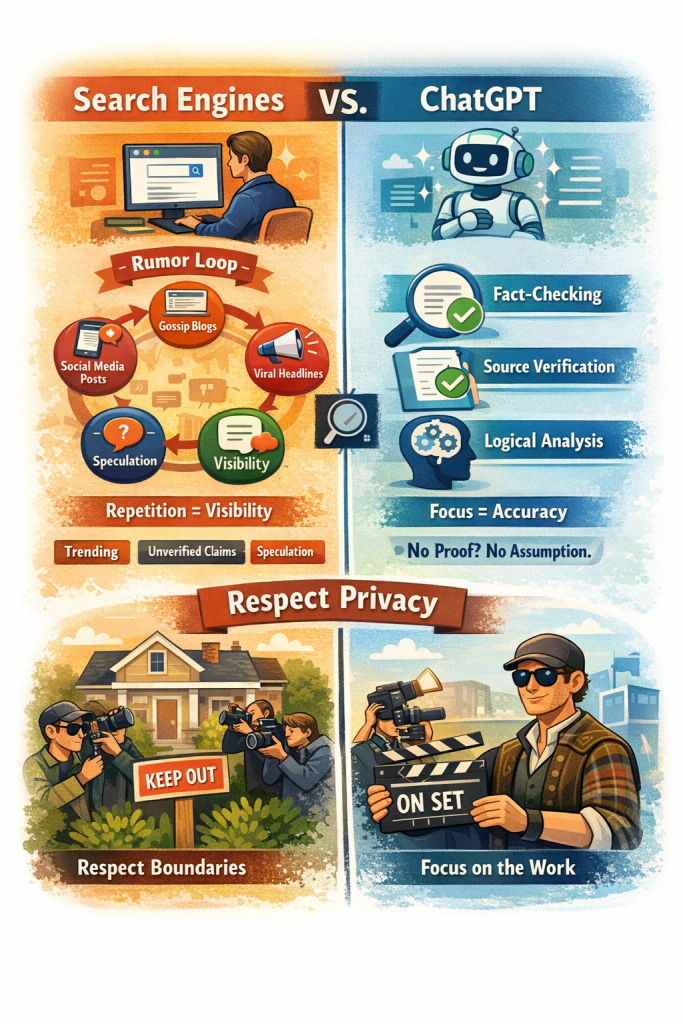
In the digital age, the way we search for information shapes not only what we believe, but how we interpret and respond to what we see. This becomes especially clear when rumors circulate about public figures. Many people turn to search engines or AI tools hoping to find clarity, yet those tools do not function the same way—and misunderstanding that difference can unintentionally fuel misinformation and unnecessary concern.
This discussion is not about rumor itself. It is about process—how information is surfaced, analyzed, and either escalated or grounded.
How Search Engines Frame Rumors
Search engines are built to collect, index, and rank content that already exists online. When someone searches a name alongside a rumor or narrative, the engine does not evaluate whether the claim is accurate. It simply gathers content where those terms appear together and ranks it based on relevance, engagement, and repetition.
As a result, search results may include social media posts, blogs referencing one another, screenshots without context, or commentary built on assumption rather than confirmation. When similar narratives appear repeatedly, they can feel validated simply because they are visible.
Search engines answer one question:
“What content exists online related to this query?”
They do not determine whether that content is verified.
How Repetition Becomes Perceived Credibility
This is where rumor loops take hold. One speculative post is shared. Others repeat or paraphrase it. Blogs echo the same ideas. Search engines index the repetition. Over time, visibility creates the illusion of consensus—even though no proof has ever been introduced.
The system rewards repetition, not accuracy. And for people who are trying to be careful and informed, this can be deeply misleading.
Where Real Concern Can Develop
Repeated exposure to the same unverified narrative can trigger genuine concern—not because someone believes gossip, but because repetition raises questions. People may worry about safety, privacy, or whether someone is being misrepresented or placed under scrutiny due to speculation spreading without restraint.
Search engines do not offer reassurance or clarification. They do not explain rumor dynamics. They simply present more content, which can unintentionally escalate concern rather than resolve it.
How ChatGPT Approaches the Same Information
ChatGPT operates from a different framework. It does not compile posts or rank narratives by popularity. Instead, it evaluates whether there is verifiable public information supporting a claim.
When a rumor is presented, ChatGPT looks for confirmation from accountable sources, checks logical consistency, examines timelines, and recognizes common misinformation patterns such as anonymous sourcing or recycled narratives. If no verified information exists, that is stated clearly.
Rather than escalating concern, this approach slows the process down and separates emotional reaction from factual conclusion.
Visibility Is Not Verification
One of the most important distinctions to understand is that visibility does not equal truth. Photos, screenshots, and anecdotes can circulate widely and still lack context or confirmation.
Search engines make information easy to find.
ChatGPT highlights what is missing.
That difference alone can prevent assumption from replacing evidence.
How I Personally Use Both Tools
I use both search engines and ChatGPT intentionally and for different reasons. I am a very intelligent person, and being autistic gives me a strong interest in patterns, systems, and how technology is used—especially in situations like this. I find it genuinely fascinating how information spreads, how tools shape perception, and how repetition can influence belief.
At the same time, I understand that both tools need to be taken with a grain of salt. Search engines can amplify noise. AI tools can analyze patterns—but neither should replace critical thinking. Technology is powerful, but it is not infallible, and discernment is always necessary.
Using these tools thoughtfully allows me to stay informed without jumping to conclusions, and curious without being pulled into speculation.
Why Respect and Boundaries Matter
As I have said many times before, Sam Heughan is a man I deeply and highly respect. He has not fallen into the common traps of Hollywood, and he has been very deliberate about maintaining his privacy. That choice alone should tell people everything they need to know.
Someone who values privacy to that degree would never expose their private life to the public, nor invite speculation or narratives about it. People should already understand this by now.
He deserves to have people in his corner—people who respect his boundaries, his humanity, and his right to a private life. The focus should always be on his work, his craft, and his contributions—not on speculation about what he has intentionally chosen to keep personal.
Using Tools Responsibly
Search engines remain useful for finding official statements, interviews, and primary sources. They are starting points, not conclusions.
ChatGPT complements that by helping evaluate credibility, logic, and confirmation. Used together, they encourage restraint, clarity, and responsible interpretation rather than rumor amplification.
Sometimes the most accurate conclusion is simply:
There is no verified information confirming this.
That answer is not dismissive.
It is responsible.
Final Reflection
Search engines show us what is being said.
ChatGPT helps us understand what can be trusted.
Using Sam Heughan as an example highlights an essential truth: repetition is not proof. In a digital world driven by speed and visibility, choosing to slow down, respect boundaries, and focus on meaningful work rather than private lives is not only intelligent—it is humane.
I want to be very clear about something, because this keeps coming up: I do not engage in speculation, and I will not agree with it.
That isn’t stubbornness. It’s discernment.
There is a significant difference between verified information and imagined narratives. I choose to operate from what can be confirmed, observed consistently, and supported by credible sources. Anything outside of that—assumptions, interpretations, “what ifs,” or stories built from unverified accounts—does not meet that standard for me.
Speculation Is Not Insight
Speculation is often framed as curiosity or intuition, but most of the time it’s guesswork dressed up as certainty. Interpreting shadows, accessories, body language, or anonymous posts as “proof” is not insight—it’s projection.
I don’t confuse projection with knowledge.
I Am Deliberate About What I Accept as Truth
I take a measured approach to information. That means:
Looking for consistency over time
Questioning sources instead of amplifying them
Separating verified facts from personal interpretation
Refusing to treat repetition as evidence
If something is real, it doesn’t need decoding, zooming, or defending. Facts stand on their own.
Respect My Boundaries
This is important: please respect my boundaries.
If speculation is something you enjoy discussing, that is your choice. But presenting it to me as fact—or expecting me to agree with it—is not something I will engage with.
If you cannot respect that boundary, I ask that you refrain from continuing the conversation and move on. This is not hostility. It is clarity.
Why I Ask People to Keep Speculation to Themselves
When speculation is brought to me, it places me in a position I’m not interested in occupying. I am not here to debate rumors, validate assumptions, or co-sign narratives that are not grounded in verification.
You are free to believe what you want. That does not obligate me to participate, agree, or entertain it.
Boundaries Are Not Disrespect
Choosing not to engage with speculative conversations is not dismissive or rude. It is a boundary. Boundaries protect clarity, respect privacy, and prevent misinformation from spreading.
I respect people enough not to circulate unverified stories. I expect that same respect in return.
What I Stand By
I stand by:
Verified information over viral narratives
Privacy over entitlement
Critical thinking over emotional attachment
Silence over spreading what cannot be confirmed
If that makes my position uncomfortable for some, I can live with that.
Final Thought
Not everything needs to be discussed.
Not every thought needs to be shared.
And not every assumption deserves agreement.
Respect my boundaries.
If you cannot, please refrain and move on.
I choose facts.
I choose clarity.
And I choose not to participate in speculation.
when it comes down to it…..people have seriously lack consideration and respect for other people because they think they own them due to being a fan or they think they have the facts when they do not especially when someone believes and VALUES TRUTH and facts and isn’t afraid to condemn misinformation because they are consistent about information.










 Deep Thinking