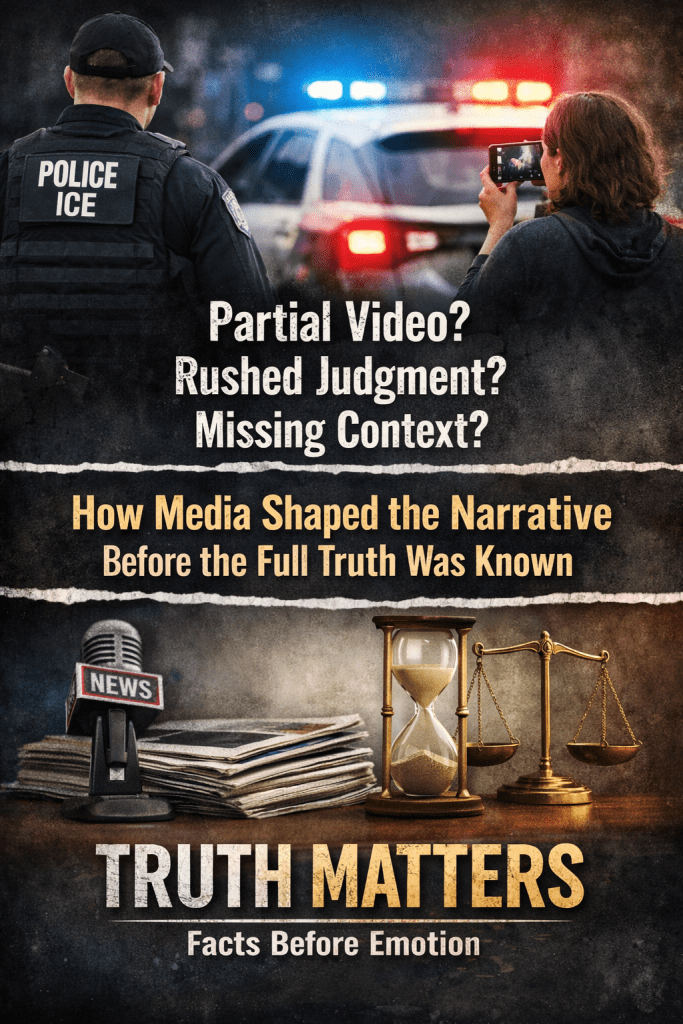
In the aftermath of the Minneapolis incident involving ICE officers, public opinion did not develop slowly or with full information. It formed quickly — largely based on how the event was first presented rather than on a complete understanding of what actually happened.
Before most people ever saw the full timeline, a narrative had already taken hold. That narrative was built around selective video clips, emotionally charged commentary, and the absence of early context. The first footage widely circulated was not the beginning of the encounter, but a later moment framed in a way that implied the officer was at fault.
Once that implication was established, everything that followed was interpreted through it.
The Order of the Clips Was Not Neutral
The first clip shown to the public began close to the moment force was used. In many cases, it was shared without clearly stating that it was partial footage rather than the full interaction.
Viewers were not initially told that:
- The clip did not show how the encounter began
- Earlier footage existed
- Verbal commands had already been issued
- The situation was still unfolding rapidly
When people are shown a dramatic moment without its lead-up, they naturally fill in the gaps. Headlines, captions, and commentary often guide those assumptions.
First impressions matter. In this case, that first impression was built on incomplete information.
What Later-Released Footage Shows
Later footage provided a broader view of the encounter.
Based on available video and official statements, two officers were present and working together.
One officer issued clear verbal commands instructing the woman to exit her vehicle. She did not comply with those instructions.
A second officer was assisting the first and positioned nearby.
At some point during this interaction, the vehicle moved backward and then forward, and contact was made with the assisting officer. Following this sequence, a weapon was discharged.
This does not answer every question, nor does it diminish the seriousness of the outcome. However, it does establish that the encounter involved noncompliance, vehicle movement, and risk to an officer — rather than a single isolated action.
That distinction matters when evaluating decisions made in seconds.
How Leaving Out the Beginning Changes Perception
When coverage begins at the moment force is used, responsibility appears to shift automatically.
Without the earlier footage:
- The officer’s actions appear sudden
- The refusal to comply is not visible
- The danger to the assisting officer is unclear
- The event appears static rather than rapidly evolving
Chronology is replaced with assumption.
By the time fuller footage becomes available, many people have already reached conclusions. At that point, added context can feel inconvenient rather than informative — even when it is essential.
Why Was the Woman There in the First Place?
Another question that received limited attention early on is why the woman was present during an active federal enforcement operation.
ICE operations do not occur randomly. Officers do not approach individuals or vehicles without a lawful reason tied to an ongoing action. While not all details have been publicly released, this encounter did not begin in a vacuum.
Some officials have suggested the woman may have been present in a way that interfered with the agents’ work. Others have disputed aspects of that claim. What has not been conclusively established is her intent.
That distinction matters. Responsible analysis requires separating what is confirmed, what is alleged, and what remains unknown. Assuming intent — either malicious or benign — without verified evidence contributes to misinformation.
If She Was Just Going About Her Business, Why Did She Refuse to Comply?
This is a reasonable question and one that deserves careful consideration.
If someone is simply going about their day, refusing to comply with clear verbal instructions during an enforcement action naturally raises concern. From an officer’s perspective, refusal to comply can signal uncertainty, risk, or potential interference — particularly when combined with vehicle movement.
At the same time, refusal alone does not establish intent. People may refuse instructions for many reasons, including confusion, fear, misunderstanding, or mistrust. What matters is acknowledging that refusal occurred while also recognizing that the motivation behind it has not been fully established.
Ignoring the refusal entirely removes a key element of the timeline and oversimplifies how risk is assessed in real time.
Why Didn’t the Officer Just Jump Out of the Way?
Another common question is why the officer did not simply jump out of the way.
This question assumes time, space, and predictability that often do not exist in fast-moving encounters. Vehicles can accelerate suddenly, change direction, and close distance in fractions of a second. Officers positioned near a vehicle may have limited room to move, obstacles nearby, or other people in the area that restrict escape.
Human reaction time under stress is extremely limited. Officers must process commands, positioning, surroundings, and the presence of others simultaneously. There may be no opportunity to calculate and execute an evasive move before impact.
This does not mean the question is invalid. It means it should be considered within the realities of real-world reaction time rather than hindsight.
How Media Framing Slips Into Propaganda
Modern propaganda does not usually rely on outright falsehoods. It relies on sequencing, omission, and emotional emphasis.
The most inflammatory moment is shown first.
Context is delayed or minimized.
Viewers are encouraged to react before understanding.
This does not require coordination or conspiracy. It thrives in fast-paced media environments driven by speed, outrage, and engagement.
Division Is the Outcome — and Often the Incentive
Outrage spreads faster than nuance. Conflict travels farther than chronology.
When stories are framed around blame rather than process, audiences are pushed into rigid camps. Nuance slows momentum. Full timelines complicate outrage. As a result, they are often sidelined.
Instead of encouraging understanding, coverage fuels rhetoric — and rhetoric fuels division.
I Don’t Take Sides — I Care About Truth
This matters to say clearly: I don’t take sides.
I’m not interested in defending institutions, attacking individuals, or aligning with political tribes. I care about what is factual, what is verified, and what is still unknown.
That means asking uncomfortable questions:
- Why do people accept media framing without verification?
- Why does emotionally driven coverage travel farther than careful reporting?
- Why is bias acknowledged but rarely challenged in practice?
These are questions of media literacy, not politics.
A Personal Pause on Propaganda
A few years ago, I found myself getting caught up in the propaganda machine as well. I didn’t recognize it at first. Like many people, I was reacting to headlines and clips without slowing down to question what I was seeing — or what I wasn’t.
I had to pause and remember something my dad always said: propaganda is the enemy of the people.
Not because it always lies outright, but because it stirs emotion before understanding. It provokes reaction instead of thought. And in the end, it doesn’t benefit anyone. It causes harm.
That reminder changed how I consume information. I slow down. I research. I look for full timelines. I try to separate verified facts from assumptions and emotionally driven narratives.
Why Accuracy Is Essential for Accountability
Accountability cannot exist without accuracy.
When blame is assigned before facts are established:
- Public debate becomes ideological
- Trust in journalism erodes
- Institutions lose credibility
- Communities fracture
Most importantly, people lose the ability to distinguish between what happened and how it was framed.
Context Is Not a Defense — It Is a Requirement
A life was lost. That deserves careful and honest scrutiny.
But scrutiny that begins with implication instead of information is not justice — it is distortion.
You cannot fairly evaluate decisions made in seconds if you are only shown one moment. And you cannot understand risk if you are never given the full sequence of events.
Final Thought
Questioning authority matters.
Demanding transparency matters.
But neither can exist without:
- Full timelines
- Verified information
- Honest framing
- Critical thinking
Truth does not need propaganda.
It needs patience and integrity.
Editor’s Note
This piece reflects information available at the time of writing. Some details remain under investigation, and additional facts may emerge. The goal here is not to assign guilt or defend any party, but to examine how media framing, partial footage, and emotional narratives can shape public perception before the full context is understood.
 Deep Thinking
Leave a comment